WhatsApp:+86 18005022363 WeChat: +86 18005022363
  Email:
Application Scenarios
At a sour-gas compression station in western Canada, the main AC 800M MCR (Main Control Room) cabinet sits 1.4 km from the wellhead ESD/I/O kiosks, which are in a Class I Div 2 area where running 20+ copper multicores through conduit was both cost-prohibitive and EMI-risky (VFDs on the nearby export compressors throw 60 Hz hash onto unbalanced RS-485). The original build used RS-485 Modbus to the remote kiosks—every lightning storm took out a transceiver. The retrofit installed a NRFc-31 on the PM891 CPU in the MCR, ran 62.5/125 µm multimode fiber through the existing tray (cheaper than new conduit because fiber needs no conduit in Div 2 if armored), and put CI854 + S800 I/O in each kiosk. The NRFc-31 forms a dual-ring: MCR → Kiosk A → Kiosk B → Kiosk C → back to MCR. Six months in, a backhoe clipped the aerial fiber between Kiosk B and C—the ring healed in ~40 ms, the AC 800M never saw a “node lost” alarm, and the compressor kept running. The E&I lead noted: “RS-485 would’ve dropped the whole string. The NRFc-31 didn’t even blink.” For plants where “I/O is far away and the ground isn’t flat,” this is the module.
Parameters
| Main Parameters | Value/Description |
|---|---|
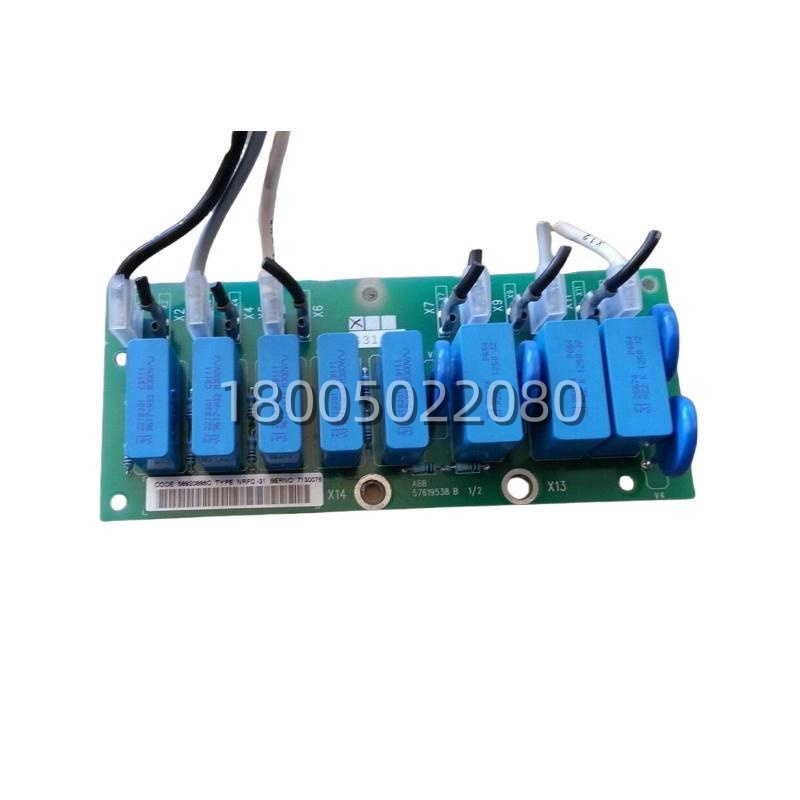
| Product Model | NRFc-31 (3BSE013258R1) |
| Manufacturer | ABB (AC 800M DCS family) |
| Product Category | Communication Expansion Module (Redundant Optical Ring) |
| Protocol | ABB Redundant Optical Ring, 10 Mbps (IEEE 802.3-based) |
| Fiber Interface | 2 × ST multimode (ring-in / ring-out) |
| Fiber Type | 62.5/125 µm or 50/125 µm multimode |
| Wavelength | 850 nm |
| Max Distance | 2 km per segment (MM fiber) |
| Max Nodes/Ring | 32 I/O stations |
| Redundancy | Dual-ring hot-standby, auto switch < 50 ms on break |
| Mounting | Right-side CEX-bus expansion of AC 800M CPU (PM8xx) |
| Operating Temp | 0 °C to +60 °C |
| Compatible Remote | CI854 communication interface module + S800 I/O |
Technical Principles and Innovative Values
- Innovation Point 1: Dual-Ring Redundancy with <50 ms Heal. The predecessor NRFc-01 supported ring topology but healed slower and lacked some of the diagnostic depth. The NRFc-31 runs a true dual-ring: data flows both directions, and if a fiber is cut or a kiosk loses power, the ring “wraps” and converges in under 50 ms—fast enough that the AC 800M task cycle (typically 100 ms) doesn’t even notice a missed scan. For compressor trains and turbine auxiliaries where “one scan drop = trip,” this matters.
- Innovation Point 2: 2 km on Multimode Eliminates Repeaters and Copper EMI. RS-485 (the AC 800M’s built-in serial) maxes out around 1.2 km and hates VFD switching, ground loops, and lightning. The NRFc-31 pushes to 2 km on cheap OM1/OM2 multimode (62.5/125), and because it’s fiber, EMI is a non-issue and there’s no ground-loop between MCR and a kiosk that sits on different earth grids (common in old refineries). No repeaters, no surge protectors, no “why is my Modbus CRC-dropping every Thursday.”
- Innovation Point 3: CEX-Bus Drop-In, No Separate Power. The NRFc-31 slides onto the right-side CEX expansion of the AC 800M CPU (PM891/PM892) and draws power + backplane comms from the CEX bus itself. No 24 V DC wiring, no separate DIN rail, no external housing. Pair it at the remote end with a CI854 (which doesneed 24 V and a DIN rail, since it’s in the remote I/O cabinet), and the architecture is: AC 800M CPU + NRFc-31 → fiber → CI854 + S800 I/O. Clean, symmetrical, documented.
Application Cases and Industry Value
Case 1 – Crude-Unit Pipe-Rack I/O (Southeast Asia Refinery): A 2020-vintage crude unit has the main AC 800M (PM892 + S800) in the MCR, but the pipe-rack ESD kiosks (fire/gas detectors, ESD valves) sit 600–1200 m away across the unit. Original design used Profibus PA + RS-485 repeaters—three repeater failures in two years (heat in the rack-mounted enclosures). The turnaround swapped to NRFc-31 on the PM892, ran armored MM fiber along the pipe rack (shared tray with instrument air, no extra conduit because Div 2 + fiber = no spark path), and CI854 + S800 in each kiosk. Two years post-retrofit: zero comms faults, even through a typhoon that flooded the rack-level cable tray (fiber stayed dry inside the armor; even if it hadn’t, 850 nm light doesn’t care about a little water). The refinery’s DCS tech noted: “The NRFc-31 is the one thing in that unit we’ve never had a Sunday callout for.”Case 2 – Run-of-River Hydro Plant (Nordic): A 45 MW hydro station has the AC 800M MCR in the powerhouse, but the intake gate, fish-ladder controls, and penstock pressure I/O sit 1.8 km upstream at the weir—too far for Profibus DP copper, and the terrain (granite + seasonal flooding) makes yearly repeater maintenance expensive. The plant runs NRFc-31 on the PM891 in the powerhouse, fiber up the access road shoulder, CI854 + S800 in the weir kiosk. During a rockslide that took out the “A” fiber (the upstream leg), the ring wrapped in ~45 ms—the AC 800M logged a “Ring Topology Change” event but never dropped the weir I/O scan. Plant ops didn’t know until the morning walkthrough. The E&I crew now keeps one spare NRFc-31 in the powerhouse spares crib and one at the weir (in an IP65 box, since the weir kiosk’s CI854 is the remote end—the NRFc-31 itself lives in the climate-controlled MCR, but they figure: “if the MCR burns, the weir needs its own path”).
Related Product Combination Solutions
The NRFc-31 is the fiber link; here’s the AC 800M ecosystem it lives in:
- CI854 – The remote-end communication interface module. Pairs 1:1 with the NRFc-31: NRFc-31 (MCR, on AC 800M CPU) ↔ fiber ↔ CI854 (remote I/O cabinet) ↔ S800 I/O modules. If you’re buying a NRFc-31, you probably also need a CI854 at the far end (or vice versa).
- PM891 / PM892 – AC 800M CPUs that the NRFc-31 expands off (right-side CEX slot). The NRFc-31 is compatible across the PM8xx family; verify your CPU’s CEX slot count (most PM89x have 2–3 CEX slots; the NRFc-31 consumes one).
- NRFc-01 – The older-generation redundant fiber module. Slower ring-heal, older diagnostics. If your plant still runs NRFc-01 and you’re seeing “ring instability” on long spans, the NRFc-31 is the drop-in upgrade (same CEX footprint, better PHY).
- S800 I/O (e.g., DI840, DO840, AI835, AO845) – The actual I/O modules that live in the remote cabinet behind the CI854. The NRFc-31 doesn’t talk to these directly; it talks to CI854, which talks to S800 over the CEX/local bus.
- SD802F / CP Series – 24 V DC PSU that feeds the CI854 + S800 in the remote cabinet (the NRFc-31 itself steals power from the AC 800M CPU’s CEX bus, but the remote end needs its own 24 V).
- NRFI-01 / NRFI-02 – ABB fiber repeaters/interface if your span exceeds 2 km (MM limit of NRFc-31) or you need single-mode conversion. Not always needed, but good to know exists.
- CEX-Bus Cable (3BSE008508R1 etc.) – The short ribbon that links NRFc-31 to the AC 800M CPU’s CEX header. Usually ships with the NRFc-31, but if you’re robbing one from a decommed CPU, grab a fresh CEX cable—the old one’s latch gets brittle after 10 years.