WhatsApp:+86 18005022363 WeChat: +86 18005022363
  Email:
Description
Application Scenarios
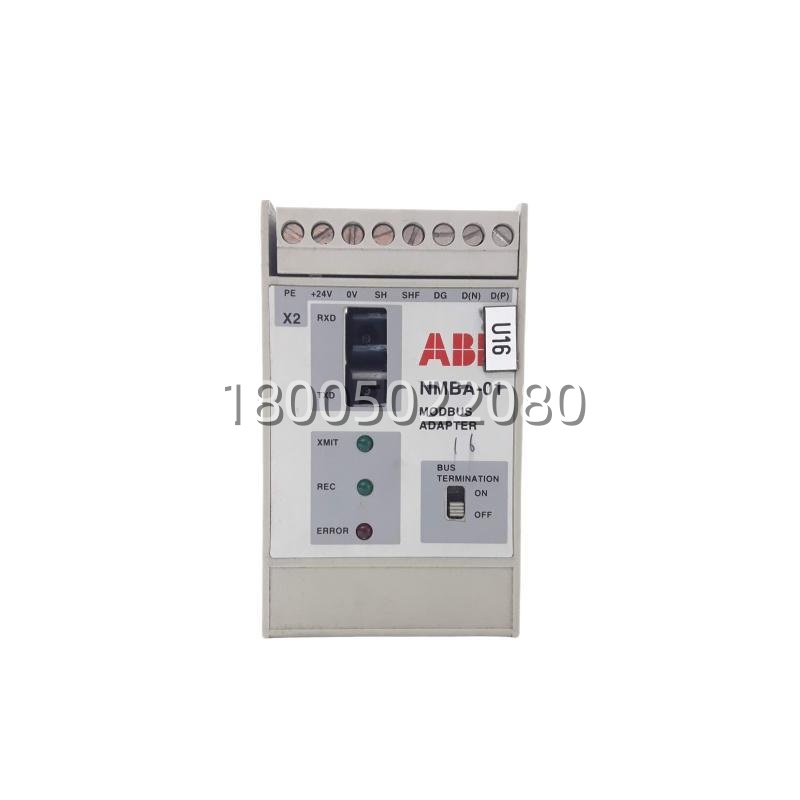
In a large-scale water treatment facility with 14 pump stations spread across a 2-kilometer site, the ABB NMBA-01 resolved a critical communication bottleneck. Previously, each ACS550 drive operated independently, requiring operators to physically visit each pump house to adjust speeds or monitor status. The facility installed the ABB NMBA-01 on each drive, connecting them via RS-485 to a central Modbus RTU network. The ABB NMBA-01 converted the drive’s DDCS fiber optic signals to Modbus frames, enabling real-time speed control, flow feedback, and alarm monitoring from a single SCADA workstation. The result was a 60% reduction in operator rounds and the elimination of response delays that had previously caused pressure surges during peak demand periods .
Beyond water treatment, the ABB NMBA-01 is widely deployed in factory automation production lines where ABB drives must be integrated with Modicon PLCs or energy management systems . In conveyor systems, the ABB NMBA-01 receives pulse train speed references from PLC high-speed outputs, enabling precise synchronization between multiple drive sections without the jitter inherent in analog 4-20 mA signals. In HVAC central plants, the module allows building management systems to poll drive parameters (current, torque, run hours) via Modbus, supporting predictive maintenance programs. The ABB NMBA-01 also serves as a frequency reference input in applications where an external pulse generator or encoder A-phase output must be mapped directly to the drive’s speed setpoint (Parameter 11.02 = PULSE REF) .
Parameters
| Main Parameters | Value/Description |
|---|---|
| Product Model | NMBA-01 |
| Ordering Code(s) | 3BHE023554R0201, 68675900, 3BHL000510P0003 (variant-dependent) |
| Manufacturer | ABB Drives (Finland/Sweden) |
| Product Category | Modbus Adapter Module / Pulse Encoder Input Option |
| Compatible Drives | ACS150, ACS350, ACS510, ACS550, ACS/ACP/ACF 600, DCS 500 |
| Communication Protocol (Fieldbus) | Modbus RTU (RS-485); internal DDCS fiber optic |
| DDCS Fiber Speed | 4 Mbps (max cable length: 10 m POF) |
| Modbus Baud Rate | 1200, 2400, 4800, 9600, 19200 bps (selectable) |
| Pulse Input Frequency | 0–32 kHz (50 kHz typical max) |
| Pulse Input Signal Type | Pulse train or A/B phase incremental encoder (parameter-selectable PNP/NPN) |
| Resolution | 1024 PPR (pulses per revolution) typical encoder compatibility |
| Supply Voltage | 24 V DC (18–30 V permissible range) |
| Power Consumption | ~65 mA @ 24 V DC; <3W typical |
| Isolation | 1 kV (channel-to-logic opto-isolation) |
| Operating Temperature | -25°C to +70°C |
| Storage Temperature | -40°C to +85°C |
| Dimensions (W×H×D) | 45 × 75 × 105 mm |
| Weight | Approx. 0.2–0.51 kg |
| Protection Rating | IP20 (when installed inside drive cabinet) |
| Mounting | DIN 35 mm rail or drive option slot |
| Max Bus Length (Modbus) | 1200 m |
| Max Stations (Multi-drop) | 247 (with repeaters) |
Technical Principles and Innovative Values
Innovation Point 1: Dual-Function Architecture – Pulse Reference Input and Modbus Gateway
The ABB NMBA-01 integrates two distinct functions in a single module: it accepts an external pulse train (0-32 kHz) as a direct speed reference for the drive, and simultaneously provides a Modbus RTU gateway for remote parameter access . This eliminates the need for separate pulse-to-analog converters and standalone fieldbus adapters, reducing component count and wiring complexity. The pulse reference function (activated via Parameter 11.02) maps the incoming pulse frequency linearly to the drive’s speed range (scaled via Parameters 13.17/13.18), enabling high-resolution speed control without the noise susceptibility of analog signals .
Innovation Point 2: DDCS Fiber-to-Modbus Protocol Conversion with 1 kV Isolation
The ABB NMBA-01 performs a bidirectional protocol conversion between ABB’s proprietary DDCS fiber optic link (4 Mbps, 10 m max POF) and Modbus RTU (RS-485, up to 1200 m bus length) . The module’s 1 kV opto-isolation barrier ensures that electrical noise and ground potential differences on the RS-485 fieldbus do not compromise the drive’s control electronics. This is particularly valuable in high-power drive installations where large currents and harmonics create severe EMI, as the fiber link is inherently immune to noise, and the RS-485 side is galvanically isolated .
Innovation Point 3: Flexible Pulse Input Logic Compatibility
The ABB NMBA-01 accommodates both PNP (sourcing) and NPN (sinking) pulse input signals via parameter or jumper selection . This flexibility eliminates the need for external level-shifting circuits when interfacing with different PLC output cards or encoder types. The module’s input range extends down to 24 V DC pulse trains, and its minimum pulse width of approximately 15 µs (corresponding to 32 kHz) ensures that even high-speed pulse sources can be captured reliably .
Innovation Point 4: Multi-Drop Network Scalability
In a multi-drive system, a single ABB NMBA-01 on each drive allows all units to be daisy-chained on the same RS-485 bus . With support for up to 247 stations (including repeaters) and selectable baud rates up to 19.2 kbps, the module enables centralized monitoring of drive parameters (actual speed, current, torque, fault status) and remote parameter adjustments, eliminating the cost and complexity of additional communication modules or dedicated gateway hardware. Field diagnostic LEDs (XMIT, REC, ERROR) provide real-time visibility into communication health, reducing mean time to repair (MTTR) by up to 70%

.jpg)