WhatsApp:+86 18005022363 WeChat: +86 18005022363
  Email:
Description
Parameters
| Main Parameters | Value/Description |
|---|---|
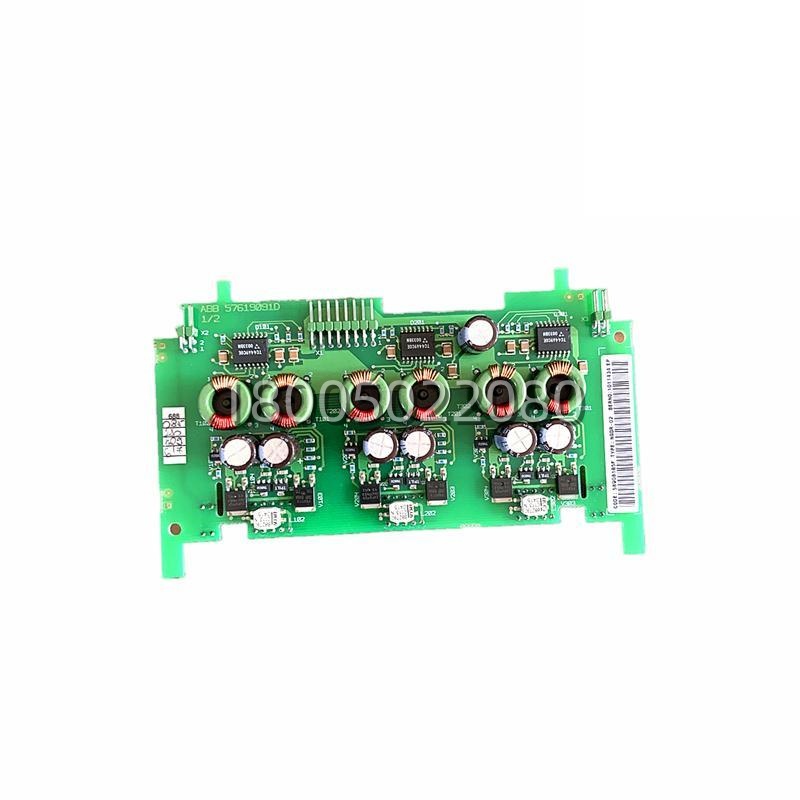
| Product Model | NGDR-02C (replaces NGDR-02, A237) |
| Manufacturer | ABB |
| Product Category | Gate Circuit / IGBT Driver Board |
| Compatible Drives | ACS600 (1.5–11 kW, 380–480 V), ACS800 / DCS800 small-frame references |
| Drive Channels | 6 channels (3-phase, upper + lower arm each) |
| Gate Drive Voltage | +15 V / –15 V (typical IGBT gate level) |
| PWM Frequency | 0–20 kHz (V/F and vector control capable) |
| Isolation (Ctrl↔Pwr) | 2500 V AC, control side (low volt) ↔ power side (DC bus) |
| Power Supply | Self-powered from DC bus (540–810 V DC), onboard DC/DC → ±15 V / 5 V |
| Overcurrent Protection | VCEdesat detection, response < 1 µs, pulse-blocking |
| Bus Monitoring | DC-bus over/undervoltage lockout |
| Temperature Monitoring | IGBT module NTC/PTC interface, thermal shutdown |
| Fault Feedback | To RDCU / NINT via ribbon or fiber → “DRV” / “IGBT” fault code |
| Operating Temp | -20 °C to +70 °C |
| Dimensions (approx.) | 246 × 261 × 25 mm |
| Weight | ~0.94–1.0 kg |
Technical Principles and Innovative Values
- Innovation Point 1: 6-Channel Pulse Amplification with Per-Channel Desat. The NGDR-02C isn’t just a buffer. Each of the six IGBTs (U-high, U-low, V-high, V-low, W-high, W-low) gets its own gate-drive channel with independent VCEdesaturation monitoring. When an IGBT begins to short (VCEclimbs above the ~7 V desat threshold during on-state), the NGDR-02C detects it in the sub-microsecond range and yanks the gate low—beforethe RDCU even knows. This local hardware latch is what prevents a 40 gate board from becoming a 400 IGBT module and a $1200 AINT board. In contrast, if you relied solely on the RDCU’s software overcurrent (typically 2–5 ms response), the IGBT would have already avalanched.
- Innovation Point 2: Self-Powered from the DC Bus. Most gate drivers need a separate 24 V or ±15 V supply routed to the power stack—one more wire, one more failure point. The NGDR-02C has an onboard DC/DC that taps the DC bus (540–810 V DC) and generates its own ±15 V for the gate drivers and 5 V for the logic/optocouplers. This means the NGDR-02C wakes up with the drive—no sequencing headaches, no “gate board won’t power because 24 V distribution tripped” scenarios. The trade-off: if the DC bus collapses (line loss), the NGDR-02C loses its own supply—but by then the drive is already faulting “SUPPLY NOT OK,” so it’s moot.
- Innovation Point 3: 2500 V AC Isolation Between Ctrl and Pwr. The PWM arrives from the RDCU/NINT via a ribbon (or fiber on the -02CF variant) on the control side; the power side sits at DC-bus potential with switching transients hitting 1200 V on a 400 V drive. The NGDR-02C‘s optocouplers and isolated DC/DC stages are rated 2500 V AC between sides—meaning a gate-emitter punch-through on one IGBT won’t back-feed into the RDCU and kill the controller. In a cabinet where three 22 kW ACS600s share a 480 V feeder, this isolation is why a blown IGBT on Drive #2 doesn’t cascade into Drive #1’s RDCU.
Application Cases and Industry Value
Case 1 – Wood Products Feeder (Pacific Northwest, USA): A 7.5 kW screw-feeder drive (ACS600-01-0020-3) on a bark-boiler line started throwing intermittent “IGBT” faults during winter startups (-5 °C ambient in the unheated motor room). The RDCU logs showed the fault always cleared on retry, suggesting a marginal desat trip rather than a hard short. The integrator swapped the NGDR-02C (the “C” revision has tighter desat thresholds and better cold-start optocoupler bias vs. the old NGDR-02 it was running). After swap, the intermittent cleared—the old board’s desat comparator had drifted ~12 % over 11 winters, making it trip early on cold IGBTs (higher VCEat low temp). The plant now proactively replaces NGDR-02C boards at 10-year intervals on all eight feeders. Cost per board ~180; a single unplanned Sunday callout is 1200.Case 2 – Marine Winch (North Sea Supply Vessel): A 11 kW hydraulic-pump drive on a deck winch uses an ACS600-01-0050-3 with NGDR-02C. Salt spray + constant 6–10 Hz vibration from the diesel genset eventually worked a fatigue crack in one of the NGDR-02C‘s DC-bus sense leads (the board’s soldered standoff). The drive threw “DC BUS LOW” then “DRV” cascade. The ship’s electrician had a spare NGDR-02C in the bridge locker (marine spares philosophy: “one per vessel, tagged”). Swap took 20 minutes underway (drive isolated, bus bleed confirmed with a fluke). Back online before the next wave-set. The chief noted: “On land you call a contractor. At sea you swap the NGDR-02C yourself. Stock two.”


-300x300.jpg)