WhatsApp:+86 18005022363 WeChat: +86 18005022363
  Email:
Description
Product Overview
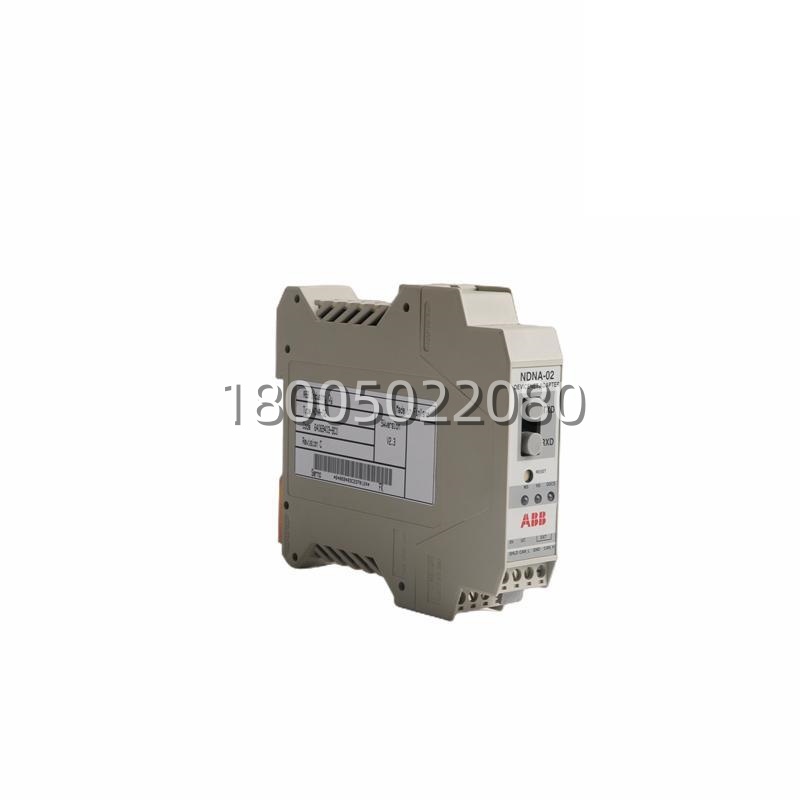
The NDNA-02 is ABB’s DeviceNet FieldBus Adapter (FBA) module, purpose-built to let ABB low- and medium-voltage drives — primarily the ACS800, ACS850, ACS610, and ACS310/ACS355 families — plug into a DeviceNet network as a slave node. In plants where the master PLC is an Allen-Bradley ControlLogix, CompactLogix, or SLC 500 (the dominant DeviceNet ecosystem), the NDNA-02 is the standard bridge: it slots into the drive’s FBA expansion bay on the RMIO or AMxx control board, draws 5 V from the control board’s backplane, and presents the drive’s control word, status word, reference, and actual values as DeviceNet I/O polling data while also exposing any drive parameter (parameter set 99, 01, 10, 20, 30, etc.) through explicit messaging. The “-KIT” suffix denotes the full mounting kit — the NDNA-02 module itself plus the drive-form-factor-specific mounting frame, the ribbon cable (NDLC-xx) to the control board, and the cover plate — so a drive that was not originally ordered with a FieldBusAdapter cutout (e.g., a bare ACS800-01 bookcase or an ACS800-04 wall-mount without the FBA door) can be retrofitted in the field without returning it to the factory.The NDNA-02 conforms to ODVA DeviceNet specifications and auto-detects baud rate across the standard triplet — 125 kbps, 250 kbps, 500 kbps — negotiated with the scanner at power-up. Node addressing is not set by DIP switches on the module (a legacy pattern); instead, ABB places it in the drive parameter set: Group 51 “FieldBus” → 51.01 “Node address” for the NDNA-02, and 51.02–51.XX for I/O data length and PPO-like mapping. This keeps the hardware generic and lets the same NDNA-02 serve any ACS800/ACS850/ACS610 frame — the kit variant is what adapts it mechanically to the drive’s outer enclosure. Front-facing, the module carries the two standard DeviceNet LEDs — MS (Module Status, green/red) and NS (Network Status, green/red) — plus a 5-pin DeviceNet open-style connector (V+, V−, CANH, CANL, Shield) that lands on the plant’s DeviceNet trunk via a T-connector or multi-drop tap.With the NDNA-02 in the FBA slot, the drive becomes a fully addressable DeviceNet slave: the PLC can start/stop, set speed/ref via the control word, read motor speed/torque/current from the status word, and — through explicit messages — read or write any drive parameter (e.g., change accel time, read fault code 31.xx, adjust PID setpoint). This is the integration path of choice in automotive body shops, material-handling crane systems (where the hoist/trolley/master PLC is almost always Rockwell + DeviceNet), pulp & paper winder sections, and any brownfield where an ABB drive needs to drop into an existing DeviceNet node table without gateway hardware.
Technical Specifications
| Parameter Name | Parameter Value |
|---|---|
| Product Model | NDNA-02 (NDNA-02-KIT = module + mounting frame + NDLC-x cable + cover) |
| Manufacturer | ABB |
| Product Type | DeviceNet FieldBus Adapter (FBA) Module |
| Compatible Drives | ABB ACS800, ACS850, ACS610, ACS355, ACS310 (drives with FBA slot on RMIO/AMxx control board) |
| Protocol | DeviceNet (ODVA conformant), ABB Drives Profile |
| Baud Rates | 125 / 250 / 500 kbps (auto-baud detect on power-up) |
| Node Address Setting | Via drive parameter (Group 51.01), not DIP switch |
| Network Connector | 5-pin open-style DeviceNet (V+, V−, CANH, CANL, Shield) |
| Host Interface | 40-pin FBA ribbon to drive control board (RMIO/AMxx) |
| Indicators | MS (Module Status) + NS (Network Status), bi-color (green/red per ODVA) |
| Supply Voltage | 5 V DC (from drive control board backplane) |
| Power Consumption | < 2 W (typical) |
| Operating Temperature | -20 … +60 °C (within drive cabinet envelope) |
| Storage Temperature | -40 … +70 °C |
| Humidity | 5 … 95 % RH, non-condensing |
| Dimensions (module only) | ~100 × 60 × 30 mm (module PCBA) |
| Weight (module) | ~0.2 kg; kit ~0.45–0.6 kg depending on variant |
| Certifications | CE, UL, cUL, ODVA conformant |
| Mounting | FBA slot on drive control board; -KIT adds drive-enclosure frame + cover |
Main Features and Advantages
ODVA-conformant DeviceNet slave with ABB Drives Profile overlay. The NDNA-02 implements the standard DeviceNet object model (Identity Object, DeviceNet Object, Connection Object) and layers ABB’s vendor-specific objects on top for drive control/status and parameter access. For a Rockwell integrator, this means the NDNA-02 drops into RSNetWorx for DeviceNet the same way a PowerFlex drive does — the EDS file (supplied by ABB, downloadable from ABB Library) imports, the scanner sees the node, and the I/O size (typically 2 or 4 bytes per direction for control/status, plus optional extended words for actual values) is selectable via Group 51 parameters. The “ABB Drives Profile” gives a consistent mapping: Control Word (16-bit, same bit semantics as Profibus PPO — bits 0=OFF1, 1=OFF2, 2=OFF3, 3=Enable op, 7=ACK fault, etc.), Reference (16-bit signed, % or rpm scaled), Status Word (16-bit, ready/running/fault/warning/alarm bits), Actual Value (16-bit, speed/current/torque selectable). An Allen-Bradley programmer who knows PowerFlex can read NDNA-02 I/O in an afternoon.Drive-parameter access via explicit messaging. Beyond the cyclic I/O (control/status words that update every DeviceNet macro-cycle, typically 5–20 ms), the NDNA-02 supports explicit messaging to any drive parameter. This is how the PLC reads the exact fault code (31.xx), adjusts accel/decel time on recipe change, or writes a new speed-trim PID setpoint without stopping the drive. The explicit path uses the ABB Drive Object (instance 100+), where Parameter Number + Subindex + Data are packed into the DeviceNet explicit request; the NDNA-02 relays it across the FBA ribbon to the RMIO, which executes the read/write and returns the response. This is slower than I/O polling (tens to hundreds of ms, rate-limited by the scanner’s explicit message queue), but it’s the mechanism that makes the NDNA-02 a full-featured integration, not just a start/stop gateway.Auto-baud + MS/NS LED diagnostics. The NDNA-02 powers up, listens on CANH/CANL, detects the baud from the living DeviceNet scanner’s preamble, and locks — no DIP switches to mis-set when moving a spare from a 125 kbps line to a 500 kbps line. The two ODVA-standard LEDs on the module fascia follow the familiar pattern: MS green = module healthy, MS flashing green = module in standby (not joined), MS red = module fault (e.g., FBA ribbon not seated, 5 V absent); NS green = on-network with I/O active, NS flashing green = on-network but I/O connection not established, NS red = bus-off (cabling fault, 121 Ω terminator missing, CAN short). A maintenance tech who knows DeviceNet can diagnose a NDNA-02 node in 30 seconds at the drive door without a laptop — “MS green, NS red” → check trunk terminators and V+; “MS red, NS off” → check FBA ribbon seating.-KIT variant for field retrofit. A key commercial/engineering point: ABB drives can be ordered “without FBA” (cheaper upfront) and the FBA bay on the control board is still there, but the drive’s outer cover has a blank plate, not a cutout for the DeviceNet 5-pin connector. The NDNA-02-KIT solves this: it bundles the NDNA-02 module + an NDLC-x ribbon cable (length matched to drive form factor — short for ACS800-04 wall-mount, longer for ACS800-01 bookcase) + a formed mounting frame that replaces the blank plate + the cover with the 5-pin DeviceNet cutout + screws/gasket. An electrician cuts the knockout (the blank plate is pre-scored), mounts the frame, seats the NDNA-02 on the RMIO FBA slot, routes the NDLC cable, lands the 5-pin on the frame’s cutout, and the drive is DeviceNet-ready. The kit variants are drive-specific (ACS800-01 vs -04 vs -07, ACS850 machinery drive, etc.), so the NDNA-02-KIT ordered must match the drive type — the module itself is the same NDNA-02 across all kits.Seamless coexistence with drive keypad and other FBAs. The NDNA-02 does not monopolize the drive’s control — the ACS800/ACS850 control location (parameter 10.01 “Ext1/Ext2” and 10.02 “Ext2” selections) lets the drive accept start/ref from the DeviceNet I/O (via FieldBus) while the keypad remains the command source for local commissioning, or vice versa. A common pattern: Ext1 = DI terminals (local pushbuttons for jog), Ext2 = FieldBus (PLC auto mode), switched by a digital input — the NDNA-02 supplies the FieldBus words but doesn’t “own” the drive unless the commissioning engineer assigns it. This flexibility is why the NDNA-02 is popular in retrofits: drop it in, land the PLC, but keep the existing DI pushbutton logic as fallback — if the DeviceNet scanner goes down, the drive still responds to the local panel.Low power, no firmware on the adapter. The NDNA-02 is essentially a CAN-transceiver + protocol ASIC + FBA interface buffer — it draws <2 W from the 5 V rail and carries no user-firmware of its own. The “intelligence” (ABB Drives Profile object emulation, I/O mapping, explicit-message relay) is handled partly on the module’s ASIC and partly on the RMIO, but there is no “NDNA-02 firmware version” to track the way there is for NPBA-12 (Profibus) or NETA-02 (Modbus TCP). This means a NDNA-02 bought today drops into an ACS800-04 commissioned in 2004 with no compatibility check — the FBA interface on the RMIO has been stable across ACS800 firmware generations (unless the drive is on very early firmware v1.x, which had FBA bugs — but that’s a drive firmware issue, not NDNA-02). The -KIT’s NDLC cable is passive too — no electronics, just ribbon.