WhatsApp:+86 18005022363 WeChat: +86 18005022363
  Email:
Description
Description
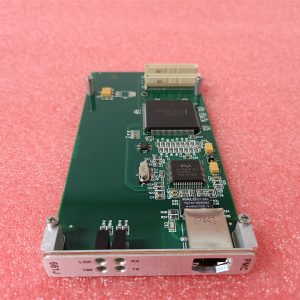
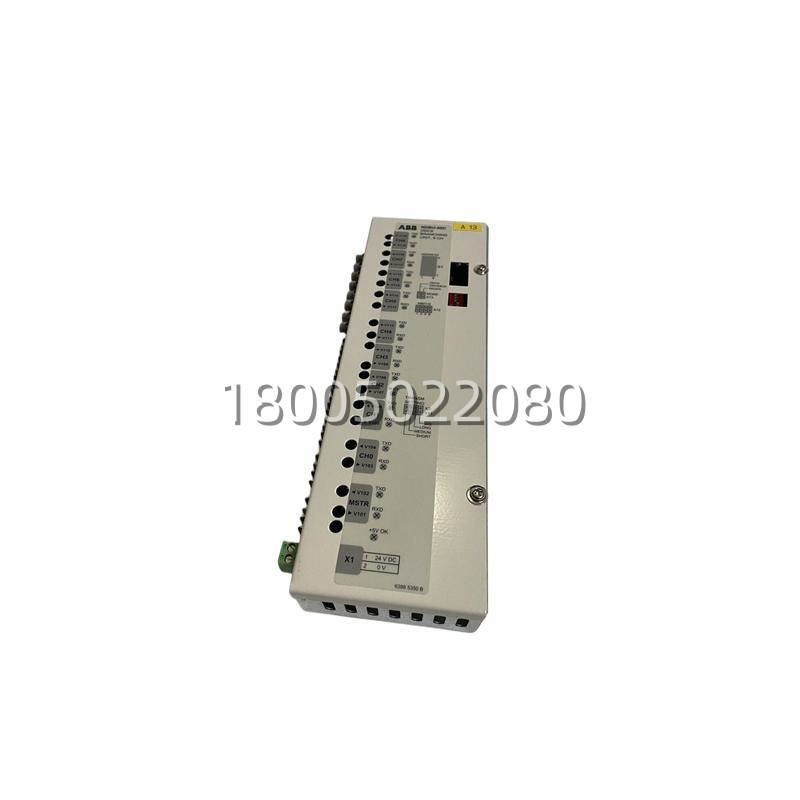
The ABB NDBU-95C is a high-performance DDCS (Distributed Drive Control System) fiber optic branching unit engineered by ABB Drives, serving as a dedicated signal distribution hub for multi-drive control architectures . This 9-channel star coupler module receives a single DDCS optical signal from a master control unit (RMIO/RCNA) and fans it out to up to nine slave power modules or inverter units, enabling robust, interference-free communication in demanding industrial drive systems .
Designed to eliminate the electromagnetic interference vulnerabilities of traditional copper cabling, the ABB NDBU-95C leverages plastic optical fiber (POF) technology to deliver reliable 10 Mbps data exchange between the master controller and distributed drive nodes . Its conformal-coated PCB and industrial-grade component selection ensure stable operation in environments where vibration, temperature fluctuations, and electrical noise are daily challenges .
Application Scenarios
In a large-scale paper mill with a 12-section sectional drive system, the ABB NDBU-95C plays an indispensable role in synchronizing multiple ACS800 inverter modules that control dryer cylinders, press rolls, and winder stations. Prior to deployment, the facility suffered from intermittent communication errors caused by electromagnetic interference from high-current motor cables, resulting in web breaks and production losses exceeding $150,000 annually. The ABB NDBU-95C resolved this critical pain point by replacing the susceptible copper-based communication links with a DDCS fiber optic star topology, delivering deterministic, noise-immune signal distribution to each drive module. The result was a 98% reduction in communication-related faults and elimination of web breaks attributed to signal loss.
Beyond paper manufacturing, the ABB NDBU-95C is deployed in crane hoist synchronization systems, where it distributes control signals to multiple hoist motors ensuring precise load sharing. In steel rolling mill applications, the module coordinates main drive and coiler drives within the DDCS network, enabling tight speed and tension control under heavy shock loads. The ABB NDBU-95C also finds extensive use in ABB DCS800-S and DCS800-EP DC drive systems, providing the same fiber optic distribution capability for thyristor power units in metal processing and mining applications .
Parameters
| Main Parameters | Value/Description |
|---|---|
| Product Model | NDBU-95C |
| Manufacturer | ABB Drives / ABB Automation |
| Ordering Code | 3AFE64008366 / 64008366D |
| Product Category | DDCS Fiber Optic Branching Unit / Star Coupler |
| Input Channels | 1 × DDCS Master In (from RMIO/RCNA) |
| Output Channels | 9 × DDCS Slave Out (to power modules/inverters) |
| Fiber Optic Type | POF (Plastic Optical Fiber, Ø 980 μm) |
| Transmission Rate | 10 Mbps (DDCS proprietary protocol) |
| Topology | Star configuration, one master to multiple slaves |
| Power Supply | 24 V DC (typical 300 mA, range 19.2–28.8 V) |
| Operating Temperature | -25°C to +55°C (industrial grade) |
| Storage Temperature | -40°C to +85°C |
| Dimensions (approx.) | 264 × 94 × 41 mm (L × H × D) |
| Weight (approx.) | 0.7 – 1.0 kg |
| Conformal Coating | Yes (C-version standard) |
| Protection Rating | IP20 (cabinet mount) |
| Channel Configuration | Independent enable/disable via DIP switches |
Technical Principles and Innovative Values
Innovation Point 1: Active Optical Signal Regeneration
Unlike passive optical splitters that simply divide light intensity with inherent signal loss, the ABB NDBU-95C incorporates active circuitry to retime and regenerate the DDCS optical signal on each output channel . This “re-drive” capability ensures that each of the nine slave outputs receives a full-strength optical signal with pristine timing integrity, enabling reliable communication over extended fiber runs and through multi-level star topologies without cumulative signal degradation.
Innovation Point 2: Star Topology with Channel-Level Isolation
The ABB NDBU-95C implements a true star architecture where the master DDCS port connects to the module, and each slave output operates as an independent, isolated branch . This design ensures that a fault—such as a broken fiber or failed transceiver—on one slave channel does not affect communication with other devices, providing inherent fault containment that ring or daisy-chain topologies cannot offer. This isolation translates to reduced troubleshooting time and minimized production impact from single-point failures.
Innovation Point 3: Noise-Immune Fiber Optic Communication
The ABB NDBU-95C fundamentally solves the electromagnetic compatibility challenges that plague high-power drive installations . By converting electrical signals to POF-based optical transmission, the module provides complete galvanic isolation between the master controller and the drive power modules. This immunity to EMI, conducted noise, and ground potential differences makes the ABB NDBU-95C the communication backbone of choice for facilities with high-power variable frequency drives, large motors, and welding equipment where copper-based communication would be unreliable.
Innovation Point 4: Configurable Output Channels
Each of the nine output channels on the ABB NDBU-95C can be independently enabled or disabled via onboard DIP switches . This field-configurable feature allows system integrators to “deactivate” unused channels, effectively creating smaller star networks with 2 to 8 nodes without requiring a different module variant. This flexibility reduces spare parts inventory, as a single ABB NDBU-95C model can support a wide range of system configurations from small 2-drive setups to large 9-drive systems.