WhatsApp:+86 18005022363 WeChat: +86 18005022363
  Email:
Description
Product Overview
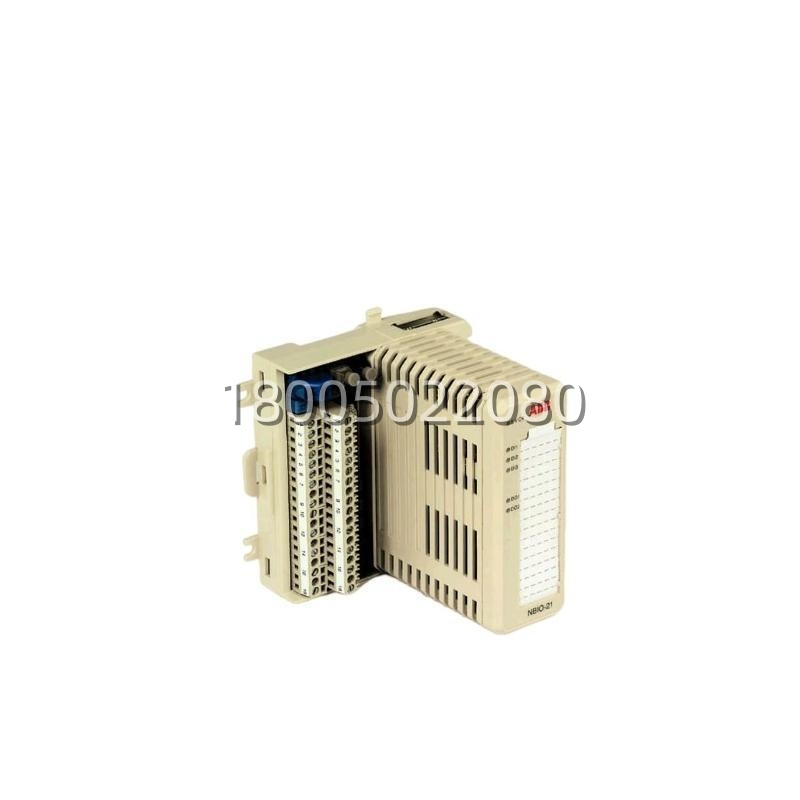
The ABB NBIO-21CU (order code 3BSE017427R1) is a universal analog input/output unit positioned within ABB’s AC500 PLC I/O family and also referenced for deployment in ABB Industrial IT / Symphony DCS environments where distributed analog interfacing is required. Unlike traditional fixed-function analog modules that lock each channel as either AI or AO at the hardware level, the ABB NBIO-21CU adopts ABB’s “free I/O” concept — all 16 physical channels are software-configurable on a per-channel basis as analog input or analog output, allowing a single SKU to cover ±10 V voltage sensing, 0/4–20 mA current loops, RTD temperature elements, and thermocouple feeds on the input side, plus ±10 V or 4–20 mA drive on the output side, all without changing the hardware. This flexibility directly reduces spare-holding SKU count for OEMs and system integrators who otherwise would stock separate AI4, AI8, AO4, AO8 modules for different machine variants.The ABB NBIO-21CU integrates into the AC500 local I/O backplane bus, drawing power and exchanging process data through the rack’s bus without separate fieldbus wiring for the I/O itself. Resolution scales with signal type — 12 to 16 bits depending on whether the channel is running voltage, current, RTD (requiring excitation and lead-compensation), or TC (requiring cold-junction compensation) — and typical accuracy holds below ±0.5 % FS, adequate for the majority of process-loop and machinery-analog duties where the downstream PID lives on the PM5xx CPU. Electrical isolation is implemented both channel-to-channel and channel-to-backplane/system-side, protecting the AC500 CPU and the backplane bus from transients and ground loops that long sensor cables in industrial plants routinely inject — a key reliability differentiator versus non-isolated low-cost analog blocks.Mechanically the ABB NBIO-21CU follows standard 35 mm DIN-rail footprint compatible with AC500 local I/O racks and also panel-mountable in Symphony-style cubicles when deployed through appropriate adapter carriers. Operating envelope is 0…+60 °C, IP20 (cabinet internal), ~0.46–0.53 kg, making it a direct-fit replacement in existing AC500 cabinets and a straightforward add-in for process skids, OEM machinery, and small-to-mid DCS nodes where a full S800 remote-I/O ring would be overspecified. For plants running mixed ABB estates — AC500 on the machine level, Symphony Plus on the process level — the NBIO-21CU offers a common analog-I/O building block that procurement can standardize on, simplifying crib inventory across layers.
Technical Specifications
| Parameter Name | Parameter Value |
|---|---|
| Product Model | NBIO-21CU |
| Order Code | 3BSE017427R1 |
| Manufacturer | ABB Ltd. |
| Product Type | Universal Analog I/O Unit (AI/AO) |
| Compatible System | ABB AC500 PLC (local I/O backplane); referenced for Industrial IT / Symphony DCS environments |
| Number of Channels | 16 (software-configurable per channel, AI or AO) |
| Input Types | Voltage 0/±10 V; Current 0/4–20 mA; RTD; Thermocouple |
| Output Types | Voltage ±10 V; Current 4–20 mA |
| Resolution | 12–16 bit (signal-type dependent) |
| Accuracy | < ±0.5 % FS (typical) |
| Isolation | Electrical isolation, channel-to-channel & channel-to-system |
| Backplane / Bus | AC500 I/O backplane bus (integrated) |
| Mounting | 35 mm DIN rail / panel mount |
| Operating Temperature | 0 … +60 °C |
| Protection | IP20 (cabinet internal) |
| Weight | ~0.46–0.53 kg |
| Typical Application | Temp / pressure / flow / level analog interfacing |
Main Features and Advantages
Software-Configurable “Free I/O” per Channel. The headline differentiator of the ABB NBIO-21CU is that none of its 16 channels are硬-wired as input or output at the hardware level — each is assigned AI or AO role inside the AC500 programming environment (Automation Builder / CodeSys), with signal subtype (±10 V, 4–20 mA, RTD, TC) also software-selected per channel. A machine builder designing three variants of a skid — one needing 10 AI + 6 AO, another 12 AI + 4 AO, a third 8 AI + 8 AO — can stock a single NBIO-21CU BOM line and configure the channel map per project. This collapses what would be 3–4 fixed-function SKUs into one, cutting crib capital and preventing “wrong module on the truck” commissioning delays.Multi-Signal-Type Coverage in One Module. On the AI side, the NBIO-21CU handles 0–10 V and ±10 V voltage, 0–20 mA / 4–20 mA current (with onboard shunt for the 4–20 mA span), 2-/3-/4-wire RTDs (Pt100/Pt1000/Ni100 typical, excitation and lead-resistance compensation internal), and thermocouples (Types J/K/T/E/R/S/B, cold-junction compensation referenced to the module’s own ambient sensor). On the AO side, ±10 V for drive-speed ref or chart-recorder feed, and 4–20 mA for valve positioners and round-indicator loops. Having RTD + TC + ±10 V + 4–20 mA all on one 16-channel block means a small process skid (temperature zones + pressure transmitters + valve-position feedback) can be wired to a single NBIO-21CU instead of splitting across three fixed-function modules — fewer modules = fewer backplane slots = smaller AC500 rack = smaller enclosure.Channel-to-Channel & System-Side Isolation. Each channel group on the NBIO-21CU is galvanically isolated from the AC500 backplane and, depending on implementation, channel-to-channel isolation is also provided — a critical feature when sensor cables run 50–200 m across a plant and pick up ground-potential differences, CMV from VFD neighbors, or lightning-coupled transients on outdoor RTD runs. The isolation barrier protects the PM5xx CPU and the backplane bus; a surge that takes out one sensor channel doesn’t propagate to the CPU or to the other 15 analog channels. In process plants where a Friday-night analog fault cascading into a CPU stop is unacceptable, this isolation architecture is a quiet but vital selling point.AC500 Backplane Integration. The NBIO-21CU seats directly on the AC500 local I/O bus — no separate 24 V feed for the analog section beyond what the AC500 rack SMPS provides, no separate fieldbus coupler, no node-address DIP switches. Process data (AI words, AO setpoints, diagnostic status) exchanges at backplane speed, well under 1 ms scan contribution, so the PM5xx PID task sees AI freshness synced to the PLC scan rather than lagged by a PN/DP IO update. For plants already on AC500, the NBIO-21CU is a zero-friction add: slot it, assign channels in Automation Builder, download, done.DIN-Rail & Form Factor. 35 mm DIN rail mounting aligns with the rest of the AC500 local I/O family and with Symphony-style cubicle DIN layouts, so panel builders don’t need special brackets. At ~0.46–0.53 kg the NBIO-21CU is light enough that DIN-clip retention is fine even with 16 screw-terminals dressed with 1.5 mm² pairs. The module’s width in the AC500 rack is standard local-I/O slice (roughly comparable to SM5xx S500 modules), so slot-count planning is predictable.Cross-Platform Spare Potential. Although primarily an AC500 local-I/O module, the NBIO-21CU is also referenced in ABB Industrial IT / Symphony-adjacent documentation as a compact analog-I/O node for smaller DCS satellite cabinets — for example, a Symphony Plus cell controller driving a small process skid where a full S800 remote-I/O ring (through INSUM or CI800/CI801) would be oversized. In those deployments the NBIO-21CU might sit on an AC500 CPU that itself is a Profibus DP or Modbus TCP slave to the Symphony cell, giving the DCS access to 16 analog points without a dedicated S800 coupler. This “one SKU, two estates” angle is useful for plants standardizing crib across AC500 machine level and Symphony process level.