WhatsApp:+86 18005022363 WeChat: +86 18005022363
  Email:
Description
Application Scenarios
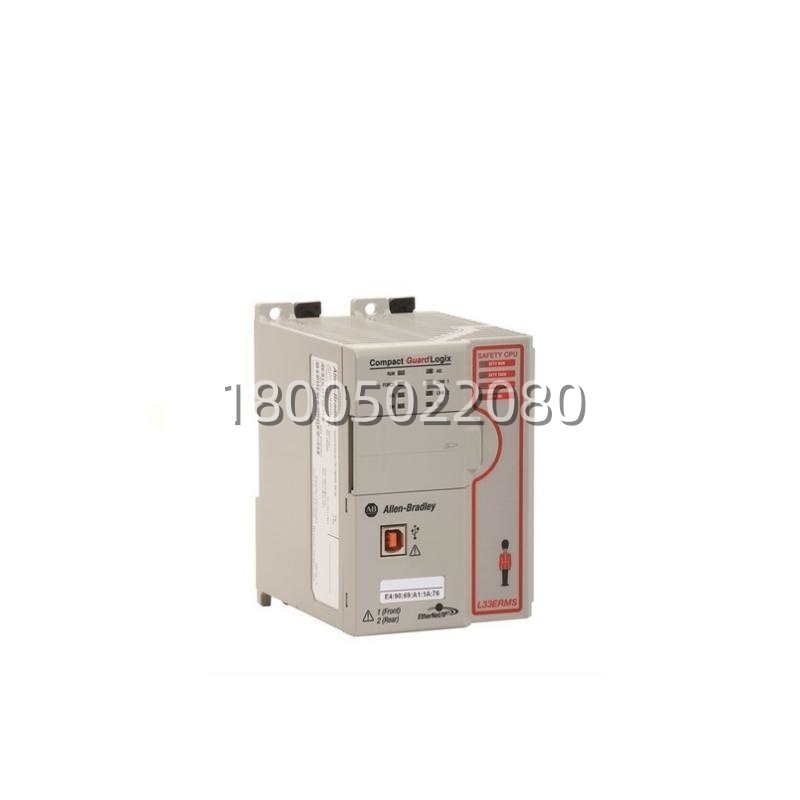
A packaging machinery OEM was building a high‑speed cartoning line requiring precise servo control for product indexing and multiple safety zones monitored by light curtains and safety gates. The legacy solution used a standard PLC plus a dedicated safety relay system, resulting in cumbersome wiring and lengthy commissioning. By adopting the 1769‑L37ERMS, the OEM consolidated all standard and safety logic into a single Studio 5000 project. The controller handled 12 axes of synchronized motion while simultaneously managing safety tasks that monitored emergency stops, door interlocks, and light curtains. Commissioning time dropped by 40%, and the integrated safety architecture simplified field troubleshooting, allowing maintenance teams to diagnose both standard and safety faults from a single programming environment-10-11.
This scenario highlights why the 1769‑L37ERMS is the preferred choice for machine builders and system integrators who need to meet SIL 3 or PL e safety requirements while maintaining high‑performance motion control in a compact footprint-7-10.
Parameters
| Main Parameters | Value/Description |
|---|---|
| Product Model | 1769‑L37ERMS (also available as 1769‑L37ERMSK with conformal coating) |
| Manufacturer | Allen‑Bradley / Rockwell Automation |
| Product Category | Compact GuardLogix 5370 L3 Safety Controller |
| Standard Memory | 4 MB – for standard logic, motion, and communication tasks-1-2-12 |
| Safety Memory | 1.5 MB – dedicated to certified safety logic execution-1-2-12 |
| Integrated Communication | 2x EtherNet/IP ports (10/100 Mbps) supporting DLR, Linear, and Star topologies; 1x USB port for programming-4-9-12 |
| Maximum EtherNet/IP Nodes | 64 nodes, including safety I/O and standard devices-1-2 |
| Integrated Motion Control | Up to 16 axes of CIP Motion with kinematics support-1-2-8 |
| Local I/O Expansion | Up to 30 local 1769 Compact I/O modules-1-2-8 |
| Non‑Volatile Storage | 1 GB SD card included; supports up to 2 GB SD card-1-2-8 |
| Safety Certification | SIL 3 (IEC 61508), PL e / Cat. 4 (ISO 13849‑1)-9-10-11 |
| Programming Software | Studio 5000 Logix Designer, version 31.00.00 or later-12 |
| Operating Temperature | 0 to 60 °C (32 to 140 °F)-10 |
| Controller Tasks | 32 tasks total (including one safety task); 1000 programs per task-12 |
Technical Principles and Innovative Values
Innovation Point 1: Integrated Standard and Safety Control on a Single Processor
The 1769‑L37ERMS runs a standard Logix task and a certified safety task concurrently within one hardware platform-7-11. This architecture eliminates the need for a separate safety PLC or external safety relays, significantly reducing hardware costs and cabinet complexity. Safety logic is developed using safety‑approved function blocks within Studio 5000, with automatic cross‑checking and watchdog mechanisms ensuring SIL 3 integrity-7-9.
Innovation Point 2: Dual‑Port EtherNet/IP with Device Level Ring (DLR) Support
The 1769‑L37ERMS features dual Ethernet ports that can be configured for DLR, linear, or traditional star topologies-1-2-12. DLR enables fault‑tolerant ring networks—if a cable fails, communication automatically reroutes within milliseconds, maintaining both standard and safety I/O connectivity. This redundancy is critical for production lines where network downtime translates to costly stoppages-1-4.
Innovation Point 3: CIP Motion with Kinematics for Advanced Motion Control
The 1769‑L37ERMS supports up to 16 axes of CIP Motion over EtherNet/IP, with integrated kinematics for coordinated multi‑axis movements-1-2-8. The “M” in the model designation indicates built‑in motion control firmware—no additional motion modules are required. This allows machine builders to implement high‑performance servo control for robotics, packaging, and assembly applications directly from the same controller that handles logic and safety-5-8.
Innovation Point 4: Battery‑Free Operation with Internal Energy Storage
Unlike older PLCs that rely on replaceable batteries, the 1769‑L37ERMS uses an internal energy storage solution to retain program and data during power loss-10-12. This eliminates battery maintenance and the risk of data loss due to depleted batteries, a common pain point in large‑scale automation installations-10.
Innovation Point 5: Unified Programming Environment with Studio 5000
The 1769‑L37ERMS is programmed using Studio 5000 Logix Designer, which supports standard ladder logic, structured text, function block diagrams, and sequential function charts for both standard and safety tasks-7-9-12. Engineers can manage logic, motion, safety, and HMI integration within a single software environment, reducing learning curves and accelerating project development-5-7.