WhatsApp:+86 18005022363 WeChat: +86 18005022363
  Email:
Description
Application Scenarios
Consider a medium-sized packaging line in a food processing facility, where the control system must handle a mix of AC proximity sensors and relay-operated solenoid valves. The 1764‑24AWA mounts directly on the DIN rail inside the control cabinet, and its 12 AC inputs accept signals from 120V AC sensors without requiring intermediate interface relays. Its 12 relay outputs, each rated for 5‑264V AC and up to 8A per common, switch the solenoids and motor contactors directly -6-13. When a sensor detects a jam, the processor—inserted into the base unit—executes the logic within milliseconds, de‑energizing the affected output and preventing product damage. The 1764‑24AWA’s wide input range of 85‑265V AC ensures stable operation even in facilities with fluctuating line voltages -6.
In a water treatment pumping station, the 1764‑24AWA communicates with a SCADA host via its built‑in RS‑232 port using DF1 or Modbus RTU protocols -11. The two built‑in trim potentiometers allow operators to adjust setpoints such as pump cycle timers without requiring a programming terminal, reducing downtime during field tuning. Plant engineers report that the base unit’s removable processor design—a hallmark of the MicroLogix 1500 family—enables them to swap processors without disturbing field wiring, cutting replacement time by nearly 70% -9-13.
Parameter
| Main Parameters | Value/Description |
|---|---|
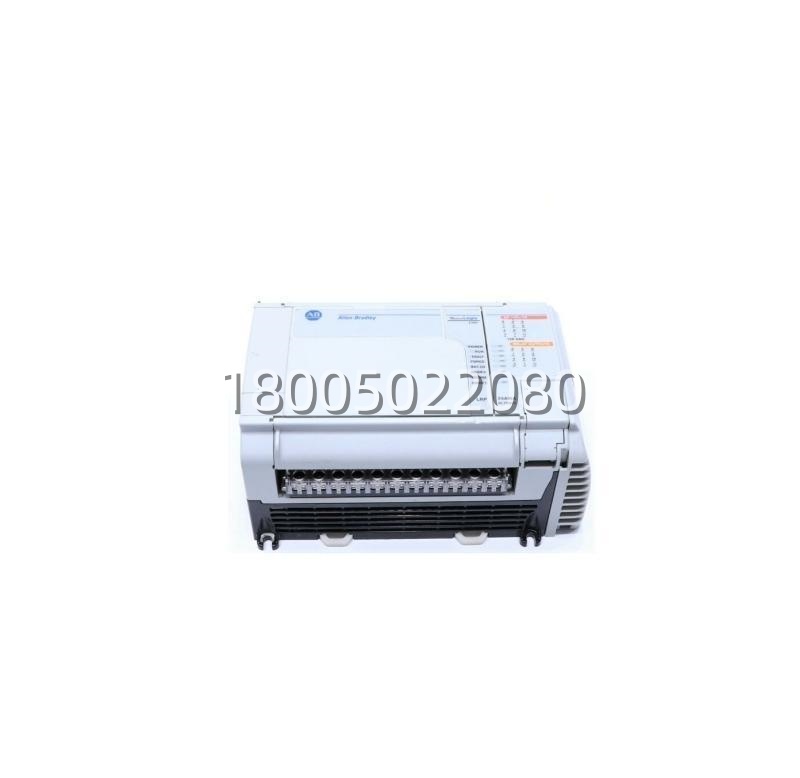
| Product Model | 1764-24AWA (MicroLogix 1500 Base Unit) |
| Manufacturer | Allen‑Bradley / Rockwell Automation |
| Product Category | PLC Base Unit (Power Supply + Embedded I/O) |
| Input Voltage (Line Power) | 85…265V AC at 47…63 Hz -6 |
| Power Consumption | 70 VA (typical) -6-13 |
| Inrush Current | 25A @120V AC for 8 ms; 40A @240V AC for 4 ms -6 |
| Embedded Inputs | 12 points, 120V AC (79‑132V AC ON range, 5mA minimum ON current) -3-6 |
| Embedded Outputs | 12 points, relay contacts (5‑264V AC / 5‑125V DC, 8A max per common) -6 |
| Load Current (5V DC bus) | 2250 mA (for powering processor and expansion I/O) -6 |
| Communication Port | RS‑232 (DF1, DH‑485, Modbus RTU Slave, ASCII) -11 |
| Operating Temperature | 0°C to +55°C -4-7 |
| Mounting Type | DIN Rail or Panel Mount -2-3 |
| Dimensions (H x W x D) | 132 x 168 x 87 mm (approx.) -4-7 |
| User Power Output | None (unlike the 1764‑24BWA variant which provides 24V DC @400mA) -3-6 |
Note: The base unit requires a processor module (1764‑LSP or 1764‑LRP) to form a complete controller -9-13.
Technical Principles and Innovative Values
Innovation Point 1: Two‑Piece Removable Processor Architecture
Unlike many compact PLCs with a fixed CPU, the 1764‑24AWA separates the processor from the I/O base. This design allows maintenance technicians to upgrade or replace the processor—switching from a 7.65K memory 1764‑LSP to a 14K 1764‑LRP, for example—without rewiring or removing the base unit. Field reports indicate this feature reduces average system recovery time from 90 minutes to under 30 minutes during processor failures -9-13.
Innovation Point 2: AC Input Front‑End with Built‑In Noise Rejection
The 1764‑24AWA inputs are engineered to operate on 120V AC with a hysteresis that ensures reliable ON‑state detection above 79V and OFF‑state below 20V. This wide differential (nearly 60V) provides exceptional immunity to electrical noise common in motor‑heavy environments -6. The inputs also feature a 20ms ON/OFF delay that debounces contact chatter, eliminating the need for external debounce circuitry and reducing component count by up to 8‑10 parts per input point.
Innovation Point 3: Integrated Relay Outputs with High Inrush Capability
Each relay output on the 1764‑24AWA is rated for 8A continuous per common (24A total per controller at 150V, 20A at 240V), with peak surge current well above standard DC output modules. This direct‑to‑load capability eliminates the need for interposing relays when driving small motor starters or solenoid valves, reducing panel space and installation cost by an estimated 15‑20% for typical 24‑point applications -6.
Innovation Point 4: Flexible Communication and Field Tuning
The built‑in RS‑232 port supports multiple protocols—DF1, DH‑485, Modbus RTU Slave, and ASCII—enabling seamless integration with legacy and modern SCADA/HMI systems -11. Additionally, the two analog trim potentiometers on the base unit allow real‑time adjustment of timer presets, speed references, or alarm thresholds, a feature rarely found in controllers of this size -11.