WhatsApp:+86 18005022363 WeChat: +86 18005022363
  Email:
Description
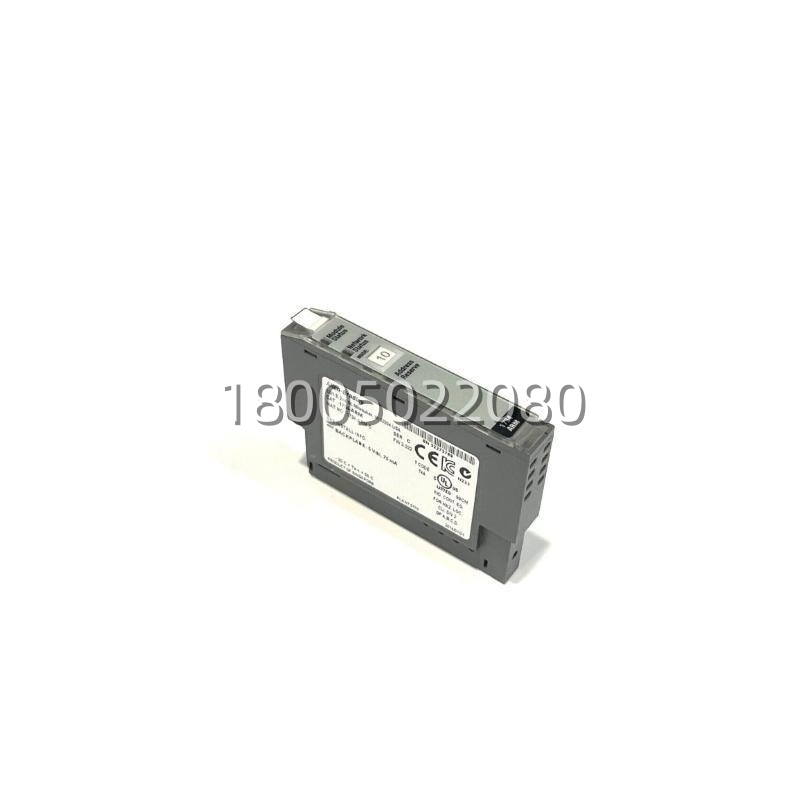
Technical Specifications
| Parameter Name | Value |
|---|---|
| Product Model | 1734-ACNR |
| Manufacturer | Rockwell Automation / Allen‑Bradley |
| Product Type | ControlNet Network Adapter Module |
| Series | POINT I/O |
| Network Protocol | ControlNet (Deterministic, 5 Mbps) |
| Input Voltage (Nominal) | 24V DC |
| Input Voltage Range | 10…28.8V DC |
| Field Side Power Requirements | 425 mA @ 24V DC |
| Inrush Current | 6 A for 10 ms |
| Power Consumption | 8.0 W (Typical); 10.2 W Maximum @ 28.8V |
| Power Dissipation | 2.8 W Maximum @ 28.8V |
| POINTBus Output Current | 1.0 A Maximum @ 5V DC |
| Module Capacity | Up to 63 POINT I/O Modules |
| Connections | 25 Direct, 5 Rack-Optimized |
| Mounting | DIN Rail (EN 60715) |
| Dimensions (H x W x D) | 76.2 mm x 54.9 mm x 133.4 mm |
| Weight | Approx. 0.33 kg |
| Operating Temperature | 0°C to +60°C |
| Isolation Voltage | 750V AC for 60s |
| Input Overvoltage Protection | Reverse Polarity Protected |
Main Features and Advantages
High-speed deterministic communication: The 1734‑ACNR provides a deterministic ControlNet interface that delivers consistent and repeatable data transfer between controllers and I/O devices-9. This ensures predictable system performance for time-critical industrial automation applications, making the 1734‑ACNR an ideal choice for processes where timing precision is essential.
Flexible and scalable I/O architecture: The 1734‑ACNR supports a modular POINT I/O design with up to 63 I/O modules per node, significantly reducing system costs and footprint-2. It allows the mixing of standard and safe I/O on the same network, providing greater flexibility and opportunities for standardization regardless of application requirements-1. This architecture also supports both local and remote I/O configurations, further reducing engineering costs in design, installation, and application development.
Enhanced connectivity and diagnostics: The 1734‑ACNR features a Network Access Port (NAP) for local programming, maintenance, and I/O monitoring without disrupting network operations-3. It supports dual redundant media for enhanced system reliability and uptime. Comprehensive diagnostics, including four red/green status indicators for adapter, POINTBus, and dual ControlNet channels, enable rapid troubleshooting and system status monitoring, minimizing downtime-5.
Robust power management and expansion: The 1734‑ACNR provides 1.0A of backplane current at 5V DC to power connected POINT I/O modules. When additional power is required, the 1734‑ACNR integrates seamlessly with 1734‑EP24DC backplane extension power supplies, each providing up to an additional 1.3A. This allows the 1734‑ACNR to support complex I/O configurations with up to 63 modules, ensuring reliable operation even in high-density installations-2-12.
Application Field
The 1734‑ACNR is predominantly used in industrial control systems requiring deterministic, high-speed communication between a controller and distributed I/O. It is the ideal solution for applications where field devices are spread across a large facility and must be reliably controlled and monitored with predictable timing. The 1734‑ACNR is a common component in the manufacturing, automotive, material handling, and packaging industries, where it facilitates the integration of sensors, actuators, and other field devices into the plant’s control architecture.
In addition to distributed I/O applications, the 1734‑ACNR plays a vital role in upgrading legacy control systems. It enables the replacement of older remote I/O racks or hardwired interfaces with a modern, modular POINT I/O system, improving system reliability, maintainability, and scalability. The 1734‑ACNR is also suited for use in redundant systems, providing the high-speed data exchange required for seamless controller failover. Its support for dual redundant media ensures that the 1734‑ACNR can withstand network cable faults, making it ideal for critical infrastructure and process industries where uptime is paramount.