WhatsApp:+86 18005022363 WeChat: +86 18005022363
  Email:
Description
Application Scenarios
A petroleum refinery running a Honeywell TPS system needed to integrate four independent Allen-Bradley SLC 500 PLCs controlling truck-loading arms, plus two on-line gas chromatographs, into the central DCS for supervisory monitoring and historical data collection. Previously these devices were read manually from local HMI panels—creating blind spots in the refinery-wide alarm system. By installing a pair of redundant NIMs each populated with a Honeywell 621-9940C, the plant configured Modbus RTU master mode on the serial ports, polled all PLC registers and analyzer composition data, and mapped them to TDC 3000 CM (Control Module) points visible on every operator console. Within one shutdown window the “islands of automation” were absorbed into the DCS, giving operators real-time truck-rack status and lab-composition trends without additional SCADA software. The Honeywell 621-9940C proved its value by maintaining stable communications through electrically noisy switchgear areas and providing detailed error counters accessible from the engineer’s console—dramatically reducing mean time to diagnose serial-link issues compared to the previous ad-hoc setup.
Parameter
| Main Parameters | Value/Description |
|---|---|
| Product Model | Honeywell 621-9940C |
| Manufacturer | Honeywell Inc. |
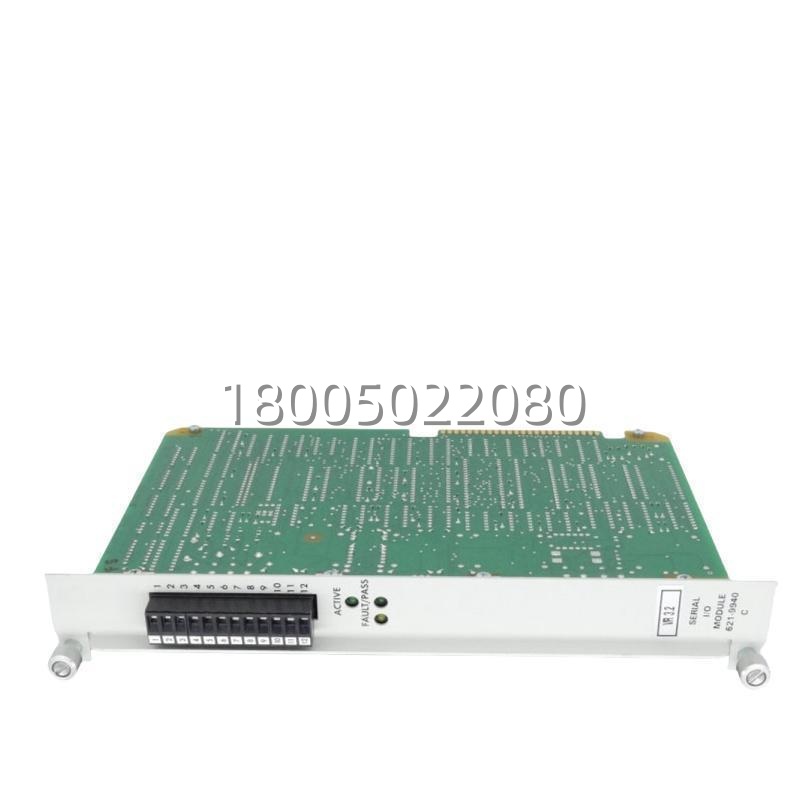
| Product Category | UCN Serial Input/Output (I/O) Communication Interface Module for TDC 3000 / TPS DCS |
| Host System Compatibility | Honeywell TDC 3000, TotalPlant Solution (TPS) — installed in NIM or PM/APM node chassis |
| Network Interface | Universal Control Network (UCN) — token-passing protocol at 5 Mbps; logical node address configurable |
| Serial Interface | 1–2 independent ports; RS-232C, RS-422, RS-485 (hardware-version dependent); DB-25 or RJ-type connector per NIM backplane |
| Supported Protocols | Modbus RTU (Master / Slave), ASCII free-format strings, Honeywell Simple Polling Protocol; protocol driver assigned in NCF |
| Baud Rate | Software-selectable: 300, 600, 1200, 2400, 4800, 9600, 19200, 38400, 57600, 115200 bps |
| Data Format | Configurable: 7/8 data bits, odd/even/no parity, 1/2 stop bits |
| Power Supply | Derived from NIM / PM node internal +5 V DC backplane bus (typical draw < 2 A) |
| Operating Temperature | 0 °C to +60 °C (control-room environment rating) |
| Humidity | 5 % – 95 % RH, non-condensing |
| Diagnostics | Module-status LEDs (PWR, ACT, ERR per port); error counters & link status viewable via US/UX & NCF; self-test on insertion |
| Physical Form Factor | Plug-in PCB module for dedicated slot in Honeywell NIM or PM/APM I/O cage; approx. 264 × 32 × 127 mm; ~0.6 kg |
| Certification | CE / UL / CSA (typical for TDC 3000 I/O modules) |
Technical Principles and Innovative Values
Innovation Point 1 — Bidirectional protocol translation at the UCN node: The Honeywell 621-9940C runs a dedicated communications co-processor that asynchronously handles serial framing, checksum validation (CRC/LRC), and time-out management on each port independently, while mapping received data blocks into UCN datagrams for the TDC 3000 application database. This offloads the PM/APM CPU and preserves deterministic control-loop execution even under heavy serial traffic.Innovation Point 2 — Multi-protocol flexibility per port: Unlike fixed-function gateways, each serial port on the Honeywell 621-9940C can be individually configured for different protocols and baud rates via NCF—allowing, for example, Port A to poll a Modbus RTU chromatograph at 19.2 kbps while Port B talks ASCII to a weigh-scale at 9600 bps—all within a single module.Innovation Point 3 — Transparent point mapping into the DCS database: Serial data acquired by the Honeywell 621-9940C is mapped to standard TDC 3000 point types (analog input, digital input, text blocks) through Normalization / Checkout procedures, making third-party device data appear indistinguishable from native Honeywell I/O to operators, historians, and control logic—no custom OPC server required.Innovation Point 4 — Integrated diagnostics accessible from the control room: Beyond front-panel LEDs, the Honeywell 621-9940C reports character-error counts, framing errors, buffer overruns, and link-up/down transitions to the TDC 3000 console. Technicians can isolate cable faults or device misconfiguration without a laptop serial analyzer, accelerating troubleshooting of the Honeywell 621-9940C links.Innovation Point 5 — Redundancy-ready in NIM pairs: When the host NIM is deployed as a redundant A/B pair, the Honeywell 621-9940C can be installed in both NIMs (matched hardware/firmware revision required), providing automatic takeover of serial communications upon NIM switchover—critical for continuous-process plants where loss of analyzer or RTU data could impact product quality or safety.
Application Cases and Industry Value
In a North American ethylene cracker, the plant’s TDC 3000 system had no visibility into two package-unit centrifugal compressors controlled by standalone microprocessor panels communicating only via RS-485 Modbus RTU. Installing a Honeywell 621-9940C in the existing NIM chassis, configured as Modbus Master at 19.2 kbps, allowed the DCS to read 32 hold registers per compressor (discharge temp, vibration Pk-Pk, lube-oil pressure, run-hours) and write setpoint adjustments. Within weeks operators detected an abnormal vibration trend trending upward via the DCS trend recorder—something previously invisible—and scheduled bearing inspection before a trip occurred, avoiding an estimated 48-hour unplanned shutdown. The refinery’s control engineer noted that the Honeywell 621-9940C “paid for itself in the first six months” by surfacing early-warning data that the original package controls could not export on their own.Similarly, in a municipal water-treatment plant modernizing only the SCADA layer while retaining legacy chlorine analyzers with RS-232 outputs, the Honeywell 621-9940C was used to bring analyzer pH / Cl₂ residual readings directly into the TPS historical database. The plant avoided replacing perfectly functional analyzers and gained centralized alarm management, reducing overtime calls for local panel checks by 70 %.