WhatsApp:+86 18005022363 WeChat: +86 18005022363
  Email:
Application Scenarios:
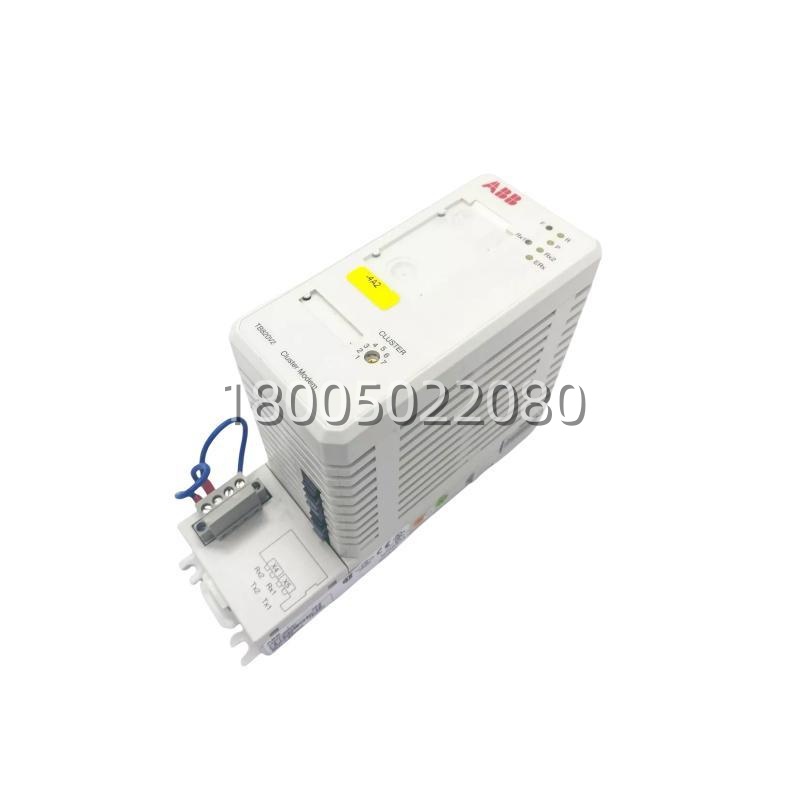
In a large petrochemical plant’s System 800xA DCS, the ABB TB820V2 is installed in a remote field enclosure located 800 meters from the central control room. The main AC 800M controller communicates via a fiber-optic ModuleBus backbone. The TB820V2 receives the optical signal, converts it to an electrical ModuleBus, and connects to a local cluster of 12 S800 I/O modules (e.g., AI, DI, DO) that monitor tank levels and control pumps. Its built-in rotary switch is set to “Cluster 3,” allowing the controller to uniquely address this remote station. Without the TB820V2, the electrical ModuleBus distance would be limited, forcing the use of expensive additional controllers or complex network bridges.
Parameter:
| Main Parameters | Value/Description |
|---|---|
| Product Model | ABB TB820V2 |
| ABB Order Code | 3BSE013208R1 |
| Manufacturer | ABB |
| Product Type | ModuleBus Cluster Modem / Optical Interface Module |
| Communication Protocol | ModuleBus (ABB proprietary high-speed bus) |
| Interface Configuration | 2x Fiber Optic Ports (Optical ModuleBus, daisy-chain) + 1x Electrical Interface (for local I/O) |
| I/O Capacity per Cluster | Up to 12 S800 I/O modules on the electrical bus |
| Cluster Addressing | Rotary switch selectable (1 to 7) |
| Power Supply | 24 V DC (typical consumption: 100 mA) |
| Operating Temperature | 0 °C to +55 °C (industrial grade) |
| Storage Temperature | -40 °C to +70 °C |
| Relative Humidity | 5% to 95% (non-condensing) |
| Protection Class | IP20 |
| Mounting | DIN rail (standard for S800 series) |
| Certifications | CE, UL, ATEX Zone 2, DNV-GL (marine) |
| Dimensions (HxWxD) | 170 mm × 58 mm × 122 mm |
Technical Principles and Innovative Values:
The ABB TB820V2 solves the fundamental challenge of signal degradation and distance limitation in distributed control systems, offering key engineering advantages over simple bus extenders.
- Innovation Point 1: Optical-Electrical Signal Regeneration for Noise Immunity. Unlike purely electrical bus extenders that are susceptible to EMI/RFI, the TB820V2 uses fiber-optic technology for the backbone connection. It receives the optical ModuleBus signal, regenerates it with precise timing, and converts it to a clean electrical signal for the local I/O cluster. This provides galvanic isolation, eliminating ground loops and making the system immune to lightning strikes and motor noise, which is critical in heavy industrial environments like steel mills or substations.
- Innovation Point 2: Deterministic Cluster Architecture for Scalability. The module implements a “Cluster” topology rather than a simple linear bus. Each TB820V2 acts as a node that can support a full cluster of 12 I/O modules. The rotary switch (1-7) allows for flexible addressing, enabling the creation of complex network topologies (star, daisy-chain) without address conflicts. This architecture allows a single AC 800M controller to manage hundreds of I/O points spread across a wide geographical area with predictable, deterministic scan times.
- Innovation Point 3: Integrated Bus and Power Supervision. The TB820V2 is not a passive repeater; it actively monitors the health of the local electrical ModuleBus and the 24V power supply. It can detect communication failures or power anomalies on its segment and report these diagnostics back to the master controller via the optical link. This enables predictive maintenance and rapid fault localization, reducing system downtime during troubleshooting.