WhatsApp:+86 18005022363 WeChat: +86 18005022363
  Email:
Description
Application Scenarios
In a large pharmaceutical batch plant, the process is controlled by a modern ABB AC 800M DCS, but critical support systems—like a legacy packaging line controlled by a Siemens PLC over PROFIBUS DP, a building management system (BMS) using Modbus TCP/IP, and a fleet of intelligent variable speed drives on Modbus RTU—all need to exchange data with the main DCS. Creating individual, custom gateways for each is costly and complex. The ABB RPBA-01 Adapter Module 1 is installed in the AC 800M controller rack. Configured with appropriate firmware, it can simultaneously manage multiple communication tasks: one port acts as a PROFIBUS DP master to poll the packaging line PLC, another serves as a Modbus TCP/IP client to read BMS data, and a serial port communicates Modbus RTU with the drives. This single module consolidates all these disparate network connections, translating protocols in real-time and presenting a unified data image to the PM/PC 892 controller CPU. It solves the critical integration pain point, enabling a “single pane of glass” for operators and ensuring seamless interoperability in a multi-vendor, multi-generation plant.
Parameter
| Main Parameters | Value/Description |
|---|---|
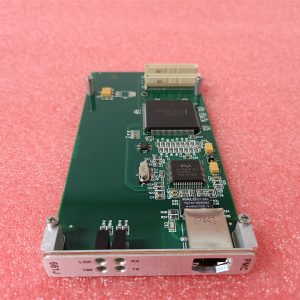
| Product Model | ABB RPBA-01 Adapter Module 1 |
| Manufacturer | ABB (Asea Brown Boveri) |
| Product Category | Communication Adapter Module / Network Interface Unit |
| Host Controller | Designed for the ABB AC 800M (e.g., PM/PC 892) controller family. Plugs into the controller’s communication module slot. |
| Modular Architecture | Base hardware platform that can be configured with different firmware for specific protocol roles. |
| Common Protocol Support | – PROFIBUS DP (Master or Slave) – Modbus TCP/IP (Client/Server) – Modbus RTU/ASCII (Master/Slave) – Ethernet/IP – IEC 60870-5-104 Note: Specific protocol is determined by loaded firmware. |
| Physical Interfaces | Typically includes: 1) Ethernet port (RJ-45), 2) Serial port (RS-232/485), 3) PROFIBUS DP port (SUB-D9). |
| Data Exchange | Manages cyclic and acyclic data exchange; maps network data to controller process variables. |
| Configuration | Fully configured and parameterized using ABB’s Control Builder M engineering software. |
| Isolation | Galvanic isolation on field network ports (serial, PROFIBUS) for noise immunity and protection. |
| Status Indication | Comprehensive LEDs for power, network activity, link status, and errors for each port. |
| Power Supply | Powered directly from the AC 800M controller’s backplane. |
| Key Feature | Firmware Flexibility: One hardware module can be repurposed for different networks by loading new firmware, simplifying spares management. |
Technical Principles and Innovative Values
- Innovation Point 1: Universal Hardware with Application-Specific FirmwareThe core innovation of the RPBA-01 is its separation of hardware and software functionality. The physical module provides robust interfaces (Ethernet, serial, PROFIBUS), while its operational role is defined entirely by the firmware (e.g., “PROFIBUS DP Master” or “Modbus TCP Server”). This means a plant can stock a single hardware spare (RPBA-01) that can be quickly reconfigured in the field to replace any failed communication module, dramatically simplifying inventory management and reducing MTTR.
- Innovation Point 2: High-Performance, Multi-Protocol Co-ProcessingThe module is equipped with a dedicated communication processor that handles all protocol-specific tasks—packet assembly, checksum validation, timing, and error handling—independently of the main controller CPU (like the PM/PC 892). This offloading ensures that complex network communications do not burden the controller’s scan time, guaranteeing deterministic execution of the control application while maintaining high-speed data exchange on multiple networks simultaneously.
- Innovation Point 3: Advanced Diagnostic and Network Management SuiteThe RPBA-01 provides deep, protocol-aware diagnostics that go far beyond simple link status. As a PROFIBUS DP master, it can identify and report specific slave failures, configuration errors, and network segment issues. As a Modbus client, it can report device timeouts and CRC errors. This diagnostic data is integrated into ABB’s Control Builder M and system HMIs, giving engineers and operators unparalleled visibility into the health of the entire connected ecosystem, enabling proactive maintenance.
- Innovation Point 4: Seamless Integration with AC 800M’s CEX-BusThe module connects to the controller via the high-speed, deterministic CEX (Controller Extension) bus. This is not a standard network connection but a tightly integrated backplane-style link. This architecture ensures extremely low latency and high reliability for data transfer between the communication module and the controller’s memory, making the field network data appear as instantly accessible I/O to the control program, which is critical for fast control loops and interlocking.