WhatsApp:+86 18005022363 WeChat: +86 18005022363
 Email:

Description
Technical Specifications
| Parameter Name | Parameter Value |
|---|---|
| Product Model | AFG10S |
| Manufacturer | Yokogawa Electric Corporation |
| Product Type | Enhanced-Type Field Control Unit (FCU) |
| System Platform | CENTUM VP / CENTUM CS 3000 |
| Processor | VR5432 RISC, 133 MHz |
| Main Memory Capacity | 32 Mbyte |
| Memory Backup | Battery retained max. 72 h; recharge min. 48 h |
| V Net Interface | Dual-redundant |
| RIO Bus Interface | Dual-redundant or single |
| Maximum Connectable Nodes | 8 node units |
| FCU Status Contact Output | 2 terminals (NC/C), 30 V DC, 0.3 A max |
| Power Supply Options | 100–120 V AC / 220–240 V AC / 24 V DC, 50/60 Hz |
| Power Consumption | 250 VA (AC); 4.5 A @ 24 V DC |
| Mounting | 19-inch rack, 8 × M5 screws with insulation bush |
| Dimensions (W × H × D) | 207 × 265.9 × 482.6 mm |
| Weight | Approx. 19 kg |
| Operating Temperature | 0 to +55 °C |
| Storage Temperature | −20 to +75 °C |
| Termination Style | M4 screw terminals for power, ground, contact output |
Main Features and Advantages
Deterministic processing core: The Yokogawa AFG10S is built around the VR5432 RISC processor clocked at 133 MHz, a chip chosen not for raw speed but for hard real-time determinism — the property that keeps every control loop, sequence step, and interlock executing inside its scheduled scan window regardless of load. This is exactly what distinguishes an AFG10S from a general-purpose industrial PC and why it remains a trusted controller for continuous processes where a few milliseconds of jitter can translate into off-spec product or a safety event.
Dual-redundant communication backbone: The AFG10S connects to operator stations and the upper control network through a fully dual-redundant V net interface, so a single cable break, coupler fault, or switch outage never severs the data path to the HIS. On the downstream side, the RIO bus can be deployed in dual-redundant mode for maximum availability, allowing the unit to drive up to eight Remote I/O node units while still surviving a bus fault. This two-layer redundancy is the architectural foundation behind the 99.99999% availability record Yokogawa publishes for the CENTUM platform.
Enhanced memory capacity: Where the Standard-type AFS10S provides 16 Mbyte, the AFG10S carries 32 Mbyte of main memory — the reason it carries the “Enhanced” designation. This doubled capacity directly translates into headroom for larger function-block databases, longer sequence tables, and denser regulatory strategies, which is why plants that have outgrown a Standard FCU typically upgrade in place to the Yokogawa AFG10S without changing the cabinet footprint or wiring.
Self-diagnosing status reporting: Two dedicated FCU failure contact output terminals (normally closed and common, rated 30 V DC / 0.3 A) wired from the AFG10S to annunciator or shutdown logic give operators an independent, hardwired indication of controller health, independent of the V net — a simple but effective safeguard recognized in most plant safety reviews.
Batteried data retention: An internal backup battery preserves application programs and process data for up to 72 hours during power outages, and recharges fully within a minimum of 48 hours after power is restored, dramatically reducing recovery time and re-engineering effort after plant-wide power events.
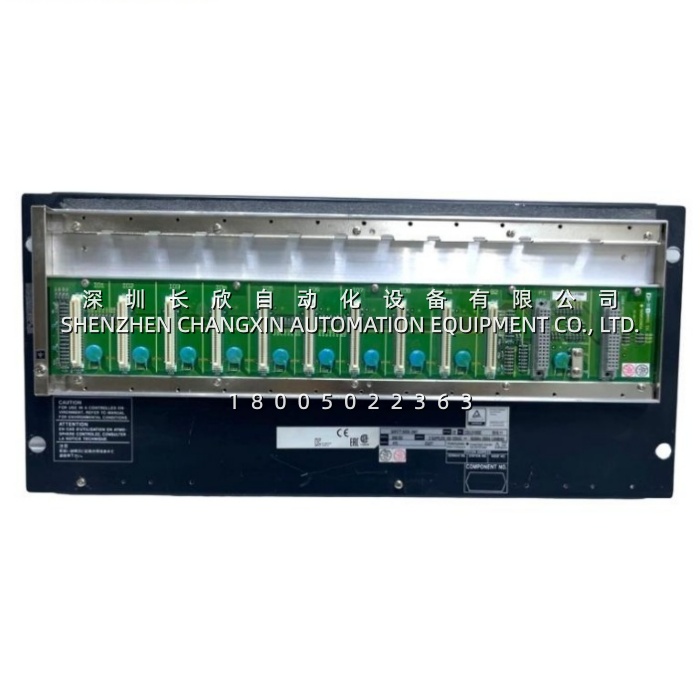
Rugged industrial construction: Housed in a 19-inch rack-mountable chassis measuring 207 × 265.9 × 482.6 mm and weighing approximately 19 kg, the AFG10S operates from 0 to +55 °C, is anchored with eight M5 screws plus insulation bush, and terminates all power, ground, and contact wiring on M4 screw terminals — built to sit in a live rack for years without service attention.