WhatsApp:+86 18005022363 WeChat: +86 18005022363
 Email:

Technical Specifications
| Parameter Name | Parameter Value |
|---|---|
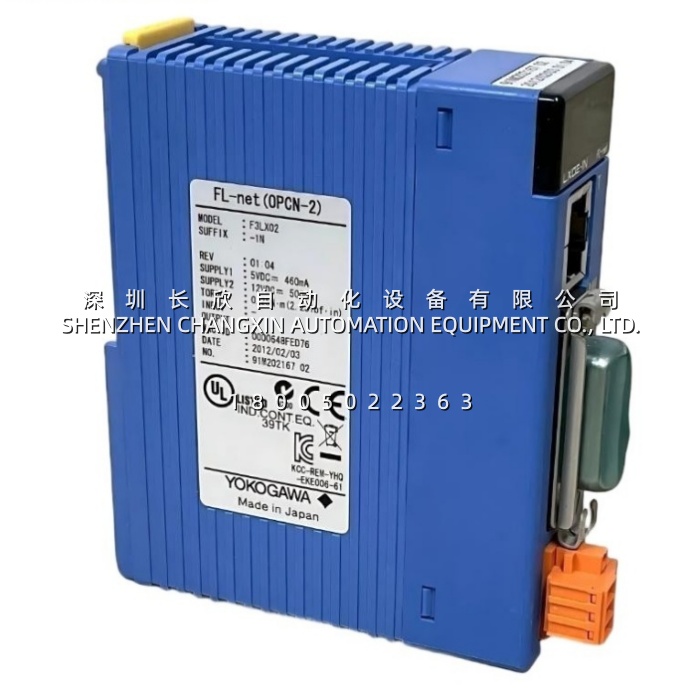
| Product Model | F3LX02-2N |
| Manufacturer | Yokogawa Electric Corporation |
| Product Type | FL-net (OPCN-2) Interface Module |
| Product Series | Yokogawa FA-M3 |
| Network Standard | FL-net (OPCN-2) Ver. 2.00 |
| Physical Interface | 10BASE-T / 100BASE-TX |
| Transmission Speed | 10 Mbps / 100 Mbps (auto-negotiation) |
| Access Control | IEEE 802.3 (CSMA/CD) |
| Protocol Stack | UDP/IP, FA link, ICMP, ARP |
| Number of Connected Nodes | 254 max. (with repeater hub) |
| Number of Installed Modules | 6 max. per FA-M3 main unit (main unit only) |
| Cyclic Transmission Capacity | 512 words (Area 1, link relays L) / 8192 words (Area 2, link registers W) |
| Message Transmission | 1024 bytes max. |
| Current Consumption | 330 mA max. |
| External Dimensions (W × H × D) | 28.9 × 100 × 83.2 mm (excluding protrusions) |
| Weight | 100 g |
| Operating Temperature | 0 °C to +55 °C (storage −20 °C to +75 °C) |
| Operating Humidity | 10 to 90% RH (non-condensing) |
| LED Indicators | RDY, LNK, COM, ERR |
Main Features and Advantages
Vendor-independent multi-controller integration: The defining strength of the Yokogawa F3LX02-2N is its adherence to the open FL-net (OPCN-2) Ver. 2.00 standard, which allows FA-M3 controllers to exchange cyclic data with PLCs, robot controllers, CNC machines, and other FA equipment regardless of manufacturer. In mixed-vendor production environments — where a Yokogawa FA-M3 supervises Mitsubishi, Fanuc, or other third-party controllers — this eliminates the need for custom gateways or protocol converters, dramatically reducing engineering effort and removing a common source of integration errors.
RRR technology for ultra-fast delivery time: The Yokogawa F3LX02-2N incorporates Yokogawa’s proprietary RRR (Rapid Refresh and Reflection) architecture, which combines fast data processing inside the interface module with an optimised exchange path to the FA-M3 CPU. The practical result is a sharply reduced delivery time — the interval between a peer node updating a link register and the local ladder program observing the new value — which is critical for synchronised production steps, coordinated robot motion, and high-speed machine-tool handshaking.
Dual transmission modes for flexible data exchange: The module supports both cyclic transmission — periodic, deterministic refreshing of Area 1 link relays (512 words) and Area 2 link registers (8192 words) — and message transmission for event-driven commands up to 1024 bytes, including transparent messages, network parameter read/write, node-status queries, and log management. This dual capability lets engineers separate time-critical process variables from supervisory commands, improving both network efficiency and application clarity.
Scalable multi-layer network architecture: Because up to six Yokogawa F3LX02-2N modules can be installed in a single FA-M3 main unit — each with independently configurable link-point allocation — large production systems can be segmented into multiple FL-net domains, each dedicated to a specific production line, process cell, or vendor group. This multi-layer approach keeps individual networks within their real-time budgets while allowing the FA-M3 to act as the supervisory hub across all of them.
Compact industrial construction with clear diagnostics: Housed in a slim 28.9 mm wide body weighing just 100 g, the Yokogawa F3LX02-2N conserves FA-M3 rack space for I/O expansion while delivering four front-panel LED indicators — RDY, LNK, COM, and ERR — that give technicians immediate visual confirmation of module health, network participation, and traffic activity. Combined with 0–55 °C operating tolerance and a well-defined LED blink pattern for setup-parameter faults, the module supports rapid commissioning and reliable long-term field operation across demanding factory environments.