WhatsApp:+86 18005022363 WeChat: +86 18005022363
 Email:

Description
Application Scenarios
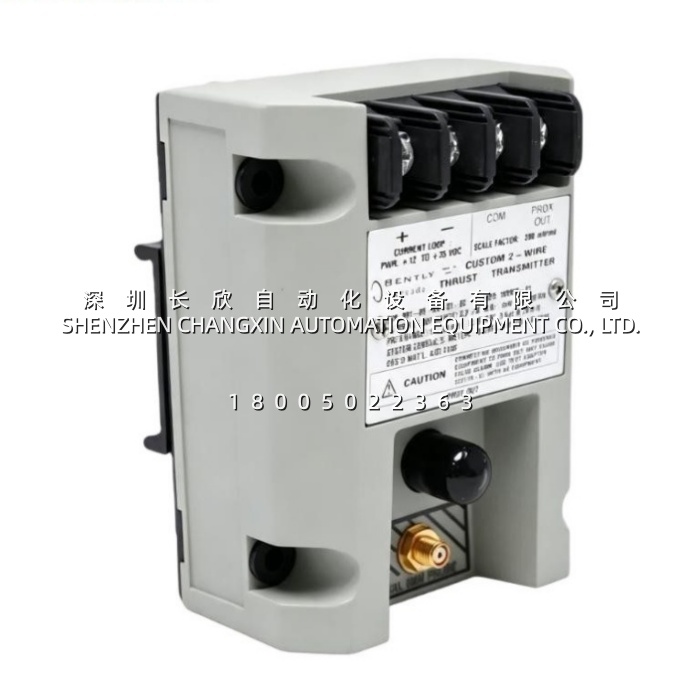
A regional compressed-air plant was experiencing periodic high axial-position readings on a packaged centrifugal air compressor. The existing control system had basic vibration monitoring, but it could not clearly distinguish normal running thrust position from a developing thrust-bearing or axial-loading problem. Maintenance engineers needed a dedicated, reliable signal that could trigger a DCS alarm before rotor position moved into a hazardous region.The plant installed the 991-10-XX-02-00 close to the compressor local panel. A 3300 NSv proximity probe was positioned to monitor the rotor thrust collar, and the transmitter’s 4–20 mA output was connected to an existing analog input channel. The operations team established normal and alarm bands around the thrust position trend, while the Not OK circuit provided a low-current fault indication if the probe or connection became defective. Within a few weeks, the plant was able to correlate thrust-position movement with process changes and bearing condition, giving operators earlier warning and reducing the need for unplanned disassembly. The solution provided a practical balance between protection capability and installation simplicity.
Parameter
| Main Parameters | Value/Description |
|---|---|
| Product Model | 991-10-XX-02-00 |
| Related Reference | 163930-01 |
| Manufacturer | Bently Nevada, Baker Hughes |
| Product Category | Thrust / axial-position transmitter |
| Measurement Type | Rotor axial displacement, also described as thrust position |
| Input | One 3300 NSv proximity probe and matched extension cable |
| Transmitter Family | Bently Nevada 991 Thrust Transmitter |
| Powering Method | Two-wire, loop-powered |
| Supply Voltage | +12 to +35 VDC at the transmitter terminals |
| Output Signal | 4–20 mA DC, proportional to axial position |
| Full-Scale Range | 0.6–0–0.6 mm, equivalent to 25–0–25 mils |
| Scale Configuration | Bidirectional range centered on zero |
| Loop Accuracy | ±1.5% of full scale |
| Maximum Loop Resistance | 1,000 Ω including cable at 35 VDC |
| Current Limiting | 23 mA typical |
| Not OK Response | Output drops below 3.6 mA within 100 µs of a Not OK condition |
| Fault Recovery | Output restored within 0.1 s after the fault clears |
| Probe Linear Range | 0.25 to 1.65 mm, equivalent to 10 to 65 mils |
| Incremental Scale Factor | 7.87 mV/µm, equivalent to 200 mV/mil, ±6.5% typical |
| Probe Temperature Range | -52 to +177 °C |
| Transmitter Operating Temperature | -35 to +85 °C |
| Transmitter Storage Temperature | -51 to +100 °C |
| Enclosure Construction | Potted for high-humidity environments up to 100% condensing |
| Mounting Code “02” | Bulkhead screws |
| Minimum Target Diameter | 9.5 mm |
| Transmitter Weight | 0.43 kg |
| System Weight | 0.82 kg typical |
| Probe Extension Cable Options | 5.0 m and 7.0 m system lengths |
| Diagnostic Output | Non-isolated PROX OUT and COM terminals plus a coaxial connector |
Technical Principles and Innovative Values
- Innovation Point 1 — Integrated Proximitor Eliminates External Signal Conditioning: The 991-10-XX-02-00 incorporates the proximity probe excitation and conditioning functions inside one compact housing. A separate external Proximitor is not required, which reduces cabinet space, wiring complexity, and potential failure points.
- Innovation Point 2 — True Two-Wire Loop Operation: The transmitter receives operating power and transmits its 4–20 mA signal over the same pair of wires. This simplifies integration with existing analog input systems and reduces cable and termination requirements.
- Innovation Point 3 — Bidirectional Axial-Position Scaling: The standard full-scale range is centered at zero and extends equally in the normal and counter directions. The output therefore reflects whether the rotor moves toward or away from the probe, which is essential for interpreting thrust-bearing behavior.
- Innovation Point 4 — Not OK and Signal Defeat Protection: The transmitter continuously checks the health of the proximity probe circuit. If the probe fails or the connection becomes loose, the output is driven below 3.6 mA rather than allowed to rise to a high, misleading value. This reduces the risk of false alarms and makes a sensor failure clearly distinguishable from an actual thrust event.
- Innovation Point 5 — Power-Up Inhibit Circuit: During startup, the 991-10-XX-02-00 suppresses transient signals that could otherwise create nuisance alarms. This helps prevent control-system trips caused by line-voltage fluctuations rather than genuine machinery conditions.
- Innovation Point 6 — Independent Zero and Span Adjustment: Non-interacting zero and span potentiometers are located beneath the transmitter label. They allow the output loop to be adjusted without one setting adversely affecting the other.
- Innovation Point 7 — Test Input for Fast Loop Verification: A dedicated test input pin accepts a variable DC voltage source, allowing personnel to verify loop output behavior without moving the probe or disassembling the machine.
- Innovation Point 8 — Built-In Diagnostic Signal Output: Non-isolated PROX OUT and COM terminals, together with a coaxial connector, provide access to dynamic transducer and gap-voltage signals. This supports condition assessment and troubleshooting while the machine remains in service.
- Innovation Point 9 — Potted Construction for Demanding Sites: The fully potted enclosure allows the transmitter to operate in environments with up to 100% condensing humidity. It is therefore better suited to compressor enclosures, outdoor panels, and other high-moisture industrial locations than an unpotted electronic assembly.
- Innovation Point 10 — Compact Physical Design: The transmitter’s small footprint and optional bulkhead-screw mounting make it suitable for installation in machinery local control panels and confined equipment spaces.