WhatsApp:+86 18005022363 WeChat: +86 18005022363
 Email:

Description
Application Scenarios
A combined-cycle gas turbine is running a combustion-case pressure, fuel-gas flow, compressor discharge temperature and three vibration-derived analog health channels into one Mark VIe rack. The plant has spent years replacing transmitters during outages because “the reading looked noisy,” and every time the answer was a field trip with a hand-held communicator, a ladder, and a permit.After the rack is built on the IS220PHRAH1A, the same work happens at a ToolboxST session. The loop current still closes the control law, but the HART secondary variables — sensor temperature, damping, self-test status, range values — arrive over the same pair. The first time a combustion-case pressure transmitter starts reporting an internal gain warning, the control room sees it days before the 4–20 mA ever drifts. They schedule the swap during the next peaker down, not during a load rejection.That is the product’s real value: it does not measure better, it makes the measurement visible. And on a machine where a surprise trip costs six figures an hour, visibility is the cheaper half of reliability.
Parameter
| Parameter | Value / Description |
|---|---|
| Product Model | IS220PHRAH1A — PHRA functional family, H1A revision; IS220PHRAH1B is the documented form-fit-function successor and the unit most often offered as the upgrade path |
| Manufacturer | GE / GE Vernova (Speedtronic Mark VIe product line) |
| Product Category | HART analog I/O pack (PHRA) — blind-mate pack, field wiring lands on a separate terminal board, not on this card |
| Channels | 12 total: 10 analog inputs + 2 analog outputs. This is the one number the channel sources agree on; “16 AI / 16 AO” listings are a different PHRA populate and are excluded |
| Input ranges | Inputs 1–8: 4–20 mA or ±5 V DC, jumper/terminal-board selected. Inputs 9–10: 4–20 mA or ±1 mA, depending on the SHRAH terminal-board populate. Pick the board to the signal, not the other way around |
| Output range | 2 channels, 0–20 mA / 4–20 mA, current-loop drive. AO load capability is commonly cited at up to 800 Ω for 4–20 mA; verify against the terminal-board revision before you size a long field loop |
| Conversion | 16-bit A/D on the inputs; 14-bit D/A on the outputs. Resolution is not accuracy, and the published accuracy cluster sits around ±0.05% to “better than 0.1%” of full scale — use the latter for safety margins until the GEH manual is in hand |
| Sampling | ~5 ms per channel (200 Hz class) with a two-pole hardware low-pass filter. Fast enough for fuel-valve and combustion dynamics; not a vibration/proximity-sensor front end — use a VSVO/VTUR pack for that |
| HART | HART-capable on both AI and AO loops, HART 5/6/7 cited across sources. The pack carries the modem; the terminal board and the loop impedance do the rest. HART is a passthrough to the controller/ToolboxST, not a master function on the pack itself |
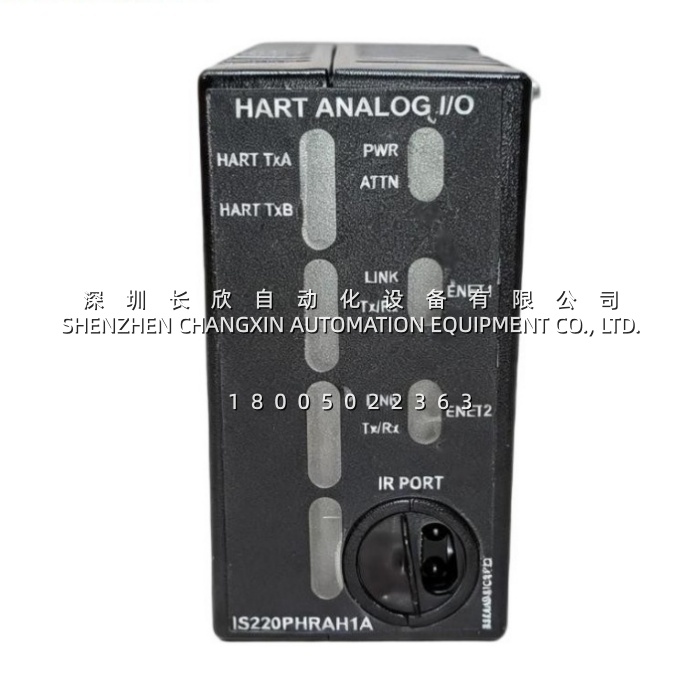
| Network | 2 × RJ45 10/100 Mb IONet (redundant path, not a switched commercial LAN) plus an IR service port. Dual ports are the expectation; do not treat ENET2 as “spare” — it is the redundancy leg |
| Pack power | 28 Vdc nominal from the IONet/backplane, typical draw ~5.3 W, max cited up to ~10 W. Size the I/O pack bus and the 24/28 V supply for the upper number, especially with 12 channels live and HART polling |
| Isolation | 2500 V AC RMS field-to-backplane galvanic isolation is the consistently cited figure. It is the reason a welded transmitter or a long field run does not walk back into the IONet PHY |
| Diagnostics | Front LEDs: power, HART Tx A/B, attention, ENET1/ENET2 link/TX-Rx. Per-channel open-loop, short-loop and out-of-range reporting is done in the pack and surfaced through ToolboxST — the LEDs tell you the pack is alive, not which loop is broken |
| Mode | Simplex only. This is the row that bites people: the H1A is not a dual-redundant or TMR pack. Redundancy for the loop comes from topology and from a second pack on a second terminal board, not from a setting inside this one |
| Environment | −30 °C to +65 °C cabinet operating, −40 °C to +85 °C storage, 5–95% RH non-condensing. IP20, cabinet-mount only — conformal-coated variants exist for salt, oil-mist and high-humidity cells |
| Form factor | Standard Mark VIe I/O-pack footprint; published dimensions cluster at roughly 82.6 × 41.9 × 121.4 mm, weight 0.5–0.9 kg depending on housing and coating. Measure your removed pack before you allocate the slot |
| Hot swap | Not hot-swappable. Remove pack power before removal. The IONet link and the loop power both need to be killed cleanly, which means a controlled outage window, not a “pull and pray” |
| Compliance | Class I Division 2 / ATEX Zone 2 is cited for the PHRA family, but the certificate is per terminal-board and coating revision. Do not write it into a HAZOP for the IS220PHRAH1A alone — confirm the cert letter for the exact assembly |
| Software | Configured and diagnosed in GE ControlST / ToolboxST alongside the Mark VIe controller project; HART device access flows through the same engineering environment |
Technical Principles and Innovative Values
Innovation point 1 — The HART payload rides the control wire, not a second network. The IS220PHRAH1A does not ask for a HART multiplexer, a fieldbus segment or a separate cable tray. The 1 mA FSK tone sits on the 4–20 mA loop, the pack recovers it, and ToolboxST gets the device data. A 200-field instrument plant suddenly has remote re-ranging and health data without pulling a single new home-run.Innovation point 2 — 10 in, 2 out is a combustion-loop shape, not a generic mix. Turbine analog racks are rarely symmetric: you measure a lot of pressures, temperatures and flows, and you drive a small number of modulating actuators. The IS220PHRAH1A is populated to that ratio, which is why one pack covers a whole combustion-case cluster where a 16-AI or 8-AO card would leave half the channels empty and the cabinet twice as deep.Innovation point 3 — Inputs 1–8 and 9–10 are deliberately different. The first eight take ±5 V as well as 4–20 mA, so legacy transducer and LVDT-conditioner feeds land without a separate signal-conditioning card. The last two are the finer-current inputs (±1 mA / 4–20 mA), aimed at the low-level or specialized transducer feeds. That split is why the terminal-board choice matters more than the pack choice — and why ordering the wrong SHRAH board turns a 20-minute install into a re-termination.Innovation point 4 — The isolation is the safety margin, not the spec sheet. At 2500 V RMS between field and backplane, a transmitter whose ground decided to move 400 V during a fault sees a transformer and an opto wall, not the IONet PHY. In a gas-turbine skid with big VFDs, a variable-frequency exciter and a shared equipment ground, that barrier is doing more work than any filter setting.Innovation point 5 — Dual IONet is the cheap redundancy. The pack has two 100 Mb ports and the controller sees the path. Lose one cable, lose one RJ45, and the loop keeps scanning. It is not a TMR controller and it is not a dual pack, but it removes the single most common cause of “analog scan dropped” — a broken patch cable nobody noticed.Innovation point 6 — It forces good loop discipline. HART only decodes when the loop impedance is right. The IS220PHRAH1A will happily measure 12.4 mA with a 90 Ω loop and throw away every HART command. That is not a defect; it is the thing that makes the commissioning crew finally check the 250 Ω, the shield bond and the cable length. A card that hides the impedance problem would be the more expensive product.
Application Cases and Industry Value
Combined-cycle gas turbine, combustion-case analog cluster. The unit fed combustion pressure, fuel-gas flow, compressor discharge temperature and three health-related analog channels into a mixed bag of AI cards and a separate HART multiplexer that had been “temporary since 2012.” The multiplexer was flaky, the scan was inconsistent, and the operators had stopped trusting the device diagnostics. The rack was rebuilt with IS220PHRAH1A packs on SHRAH2A terminal boards: ten inputs for the measurement cluster, two outputs for the fuel-valve and I/P loops. Same 4–20 mA home-runs, no new cable. Within the first month a pressure transmitter flagged an internal gain warning via HART while the loop was still in tolerance; it was swapped on the next peaker down. The multiplexer came out of the cabinet, the scan flattened, and the change record was a terminal-board swap instead of a controls migration.Steam-turbine DEH skid, valve-position and drain-instrument loop. Here the pain was the other way round: two AO channels driving I/P converters for governor and bypass-valve trim, with the input side carrying LVDT-derived and pressure signals that needed ±5 V as well as mA. A generic 16-AI pack would have forced a second card and a separate AO pack; the IS220PHRAH1A put the whole local cluster in one slot. Commissioning caught the classic mistake early — the AO loop had been sized for a 250 Ω load and the field cable plus the I/P was closer to 700 Ω. Because the pack reports out-of-range per channel, the problem showed up in ToolboxST as a loop-fault, not as a valve that “moved funny.” The cable was re-run before the turbine ever saw a load step.