WhatsApp:+86 18005022363 WeChat: +86 18005022363
 Email:

Description
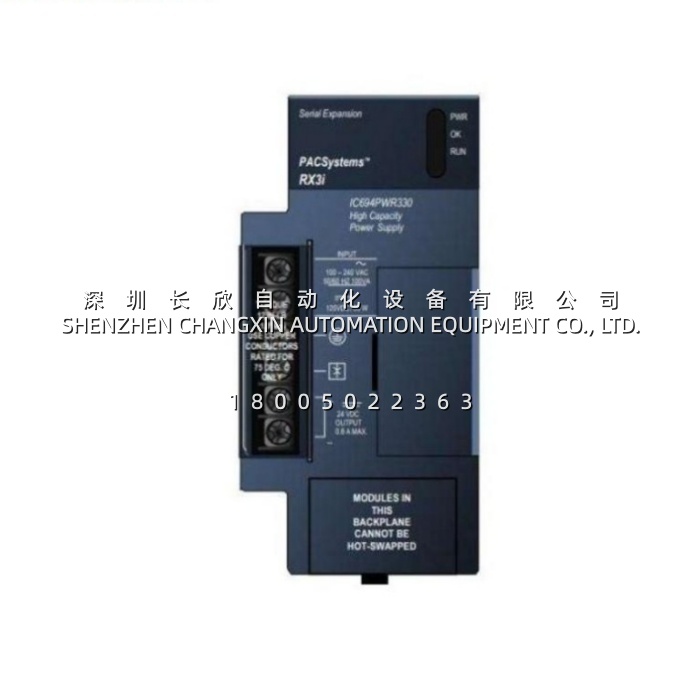
Technical Specifications
| Parameter | Value |
|---|---|
| Product Model | IC694PWR321B |
| Series / Revision | Series B (successor to IC694PWR321 / IC694PWR321A) |
| Manufacturer | GE Fanuc Automation, later Emerson Automation Solutions |
| Product Family | PACSystems RX3i |
| Product Type | Expansion Power Supply Module (24 VDC input) |
| Input Voltage | 24 VDC nominal, 19.2 – 30 VDC operating window |
| Input Current | approx. 1.3 A @ 24 VDC (2.1 A inrush at turn-on) |
| Output Power | approx. 30 W delivered to RX3i backplane rails |
| Output Rails | 5 VDC, 3.3 VDC and auxiliary backplane supplies (internal regulation) |
| Maximum Rated Power | 36 W (module rating; derated to ~30 W usable) |
| Fusing | Internally fused on the 24 VDC input; no field-replaceable fuse |
| Isolation | Isolation between 24 VDC input and backplane logic rails |
| Rack Fit | RX3i universal backplane, expansion position (right of CPU / I/O) |
| Compatible Backplanes | IC695CHS012 (10-slot), IC695CHS016 (16-slot), IC695CHS010 (bare universal) |
| Status Indicators | OK / Power-good LED; OK = steady green when rails are in tolerance |
| Battery | None on module (CPU retains battery / real-time clock function) |
| Hot-Swap Capability | Yes, within RX3i online-maintenance rules and with the alternate supply healthy |
| Operating Temperature | 0 °C to +60 °C (32 °F to 140 °F) |
| Storage Temperature | –40 °C to +85 °C |
| Humidity | 5% to 95% RH, non-condensing |
| Dimensions | 133.4 × 25.4 × 101.6 mm (5.25 × 1.0 × 4.0 in.) single-slot profile |
| Weight | approx. 0.20 – 0.23 kg |
| Agency Ratings | cULus, CE, RoHS; designed to IEC 61131-2 environmental class |
| Status | Mature product; supplied as new-surplus or reconditioned |
Main Features and Advantages
It solves the problem that looks like a bad I/O card. Most RX3i “card faults” that vanish after a reseat are actually a backplane rail that is fine at idle and collapses under load. The GE IC694PWR321B adds a clean, regulated 30 W of headroom exactly where the I/O sits, so a fully populated 16-slot backplane with mixed analogue, thermocouple and communications cards stays inside the voltage envelope. Before you condemn an analogue input card for “drifting at temperature,” check the OK LED on the expansion supply — it is usually the first honest witness.24 VDC in, quiet logic out. Feeding the module from the plant’s regulated 24 VDC field bus keeps the rack free of an extra mains-derived switcher and the HF common-mode noise that comes with it. The input is internally fused and the input-to-backplane isolation barrier stops a field-side ground loop or a shorted 24 VDC device from walking onto the 5 VDC and 3.3 VDC logic rails. In a cabinet where VFDs, contactors and solenoid banks share the same DIN rail, that barrier is the difference between a stable rack and one that throws a random backplane fault every time a motor pulls current.Series B without a re-wire. The IC694PWR321B was engineered as a like-for-like replacement for the A-series and the original non-suffixed module. Same terminal block, same single-slot profile, same 19.2–30 VDC window, same OK semantics. A swap is a power-down of the 24 VDC leg, a slide out, a slide in, and a re-energise — no new cut sheet, no backplane change, no control-logic download. For a site under change control, that “nothing changed” quality is the whole reason the B-series is specified.No battery confusion, no flat-cell surprises. Earlier automation power modules trained technicians to expect a coin cell on the board, and a missing holder tends to trigger a frantic search through the spares bin. The GE IC694PWR321B has none, by design: battery retention and the real-time clock live on the CPU. Understanding that fact prevents the two mistakes that follow — forcing a battery into a non-existent holder and, worse, assuming the module is faulty because the clock did not survive a power loss.Predictable failure mode, contained fault. A short on the 24 VDC input blows the internal fuse and the module stops contributing; it does not drag the CPU rail down, and it does not thermal-runaway through the backplane. The OK LED goes out, the rack logs a power-supply fault, and the redundant or primary supply keeps the critical path alive. That clean hand-off is what lets operations defer a repair to a turnaround instead of treating a PSU fault as an emergency shutdown.
Application Field
The GE IC694PWR321B is found wherever an RX3i rack grew after it was first commissioned. The classic case is a machine cell or skid that started with a CPU, a handful of digital I/O and a single analogue card, then acquired a second analogue bank, a profibus or Ethernet module and a thermocouple/millivolt card during a capacity upgrade. The original rail budget is suddenly tight, and rather than re-architect the cabinet around a new main supply, the plant drops a IC694PWR321B into the expansion slot. The I/O map, the wiring and the control logic are unchanged; only the thermal and electrical headroom improves.In process and utility service the module is equally common in the I/O-heavy end of the rack. Water and wastewater lift stations, boiler and burner-management auxiliaries, compressor and pump skids, and packaging or material-handling lines all tend to concentrate mixed I/O in one place. A 16-slot IC695CHS016 loaded with high-density 24 VDC inputs, relay outputs and several analogue channels will happily exceed the CPU-side budget without anyone noticing until the hottest day of the year. Installing the GE IC694PWR321B moves the margin back and makes the rack’s power story auditable: each module’s load is known, the OK LED is visible, and a failed supply is a ten-minute swap rather than a guess.The module also earns its place during migration. Plants moving from Series 90-30 to RX3i often inherit a rack population that was sized for the older family’s power profile and then grows again under RX3i’s richer I/O mix. Because the IC694PWR321B is a Series B part with the modern RX3i backplane interface, it is the correct bridge unit: keep the existing I/O, keep the program, and add power where the new cards demand it. It is the cheapest form of capacity expansion a PACSystems rack can buy, and it is far safer than “just another card” on an already loaded rail.