WhatsApp:+86 18005022363 WeChat: +86 18005022363
 Email:

Description
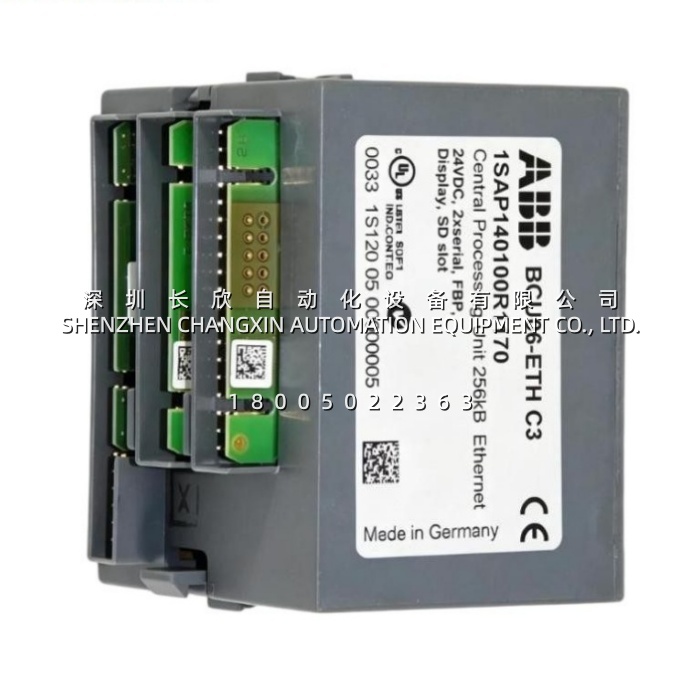
Application Scenarios:
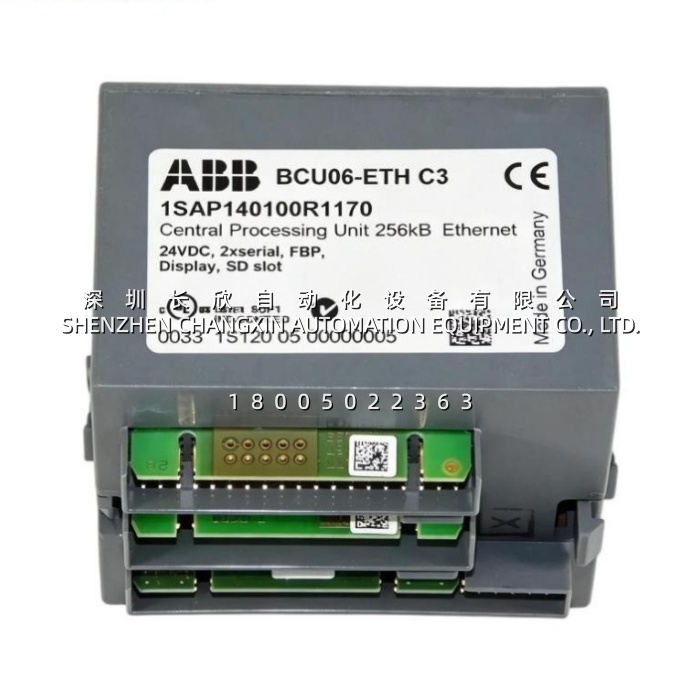
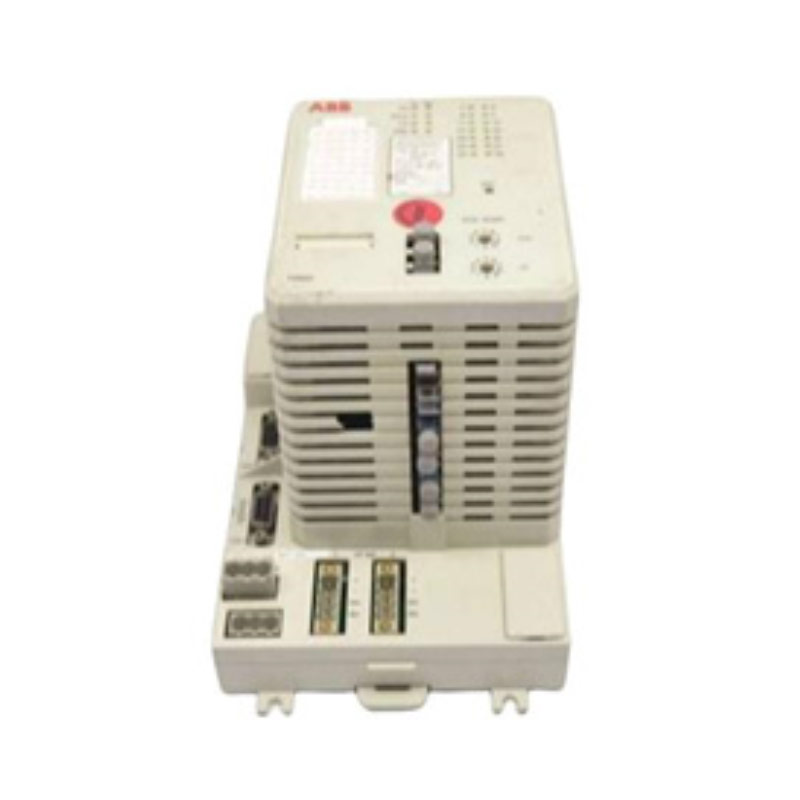
Consider a water treatment plant operating a distributed filtration train built around ABB’s AC31 architecture — twelve remote I/O stations feed filter valves, chemical dosing pumps, blower motors, and level instrumentation back to a central control panel, and the original CPU has just failed after twenty years of continuous service. Dropping a BCU06-ETH C3 1SAP140100R1170 into the same slot solves the problem without a control-philosophy redesign: the CS31 system bus is reconnected to the existing remote stations, the two serial ports pick up the Modbus link to the chlorination analyser and the ASCII link to the plant alarm printer, and the Ethernet port brings the controller directly onto the plant backbone for SCADA integration. Pain points such as protocol fragmentation across legacy serial devices, the cost of replacing installed CS31 I/O, and the absence of a native SCADA path on older AC31 CPUs are all resolved in one module — which is why the BCU06-ETH C3 1SAP140100R1170 remains a go-to processor for brownfield AC31 retrofits in water/wastewater, power-generation auxiliaries, building management, and OEM machine control applicationsabb.com+1.
Parameter:
| Main Parameters | Value / Description |
|---|---|
| Product Model | BCU06-ETH C3 (1SAP140100R1170) |
| Manufacturer | ABB |
| Product Category | Central Processing Unit — Advant Controller 31 (AC31) Basic Unit |
| User Memory | 256 kB user program / data capacity |
| Power Supply | 24 V DC nominal, with reverse-polarity protection |
| Ethernet Interface | Integrated 10/100 Mbps Ethernet port for SCADA, HMI, and peer-to-peer communication |
| Serial Ports | 2× serial — COM1 (programming / ASCII / MMC), COM2 (Modbus master & slave / ASCII / MMC) |
| Fieldbus Interface | FieldBusPlug (FBP) connector for optional communication module (e.g., PROFIBUS-DP, DeviceNet, AS-i) |
| System Bus | CS31 system bus interface for distributed remote I/O and slave units |
| Storage | SmartMedia / SD card slot for user program, data logging, and firmware/OS updates |
| Integrated Display | On-board display for status and diagnostic indication |
| Real-Time Clock | Battery-backed RTC for time-stamped events and data records |
| Programming Software | AC31 / AC31GRAF — IEC 61131-3 compliant (LD, IL, SFC, FBD) |
| Country of Origin | Sweden |
Specifications compiled from ABB AC31 product documentation, Advant Controller 31 technical literature, and verified reseller listingswiautomation.com+3.
Technical Principles and Innovative Values:
- Innovation Point 1 — Native Ethernet on a legacy AC31 platform. The BCU06-ETH C3 1SAP140100R1170 is one of the few AC31 basic units to carry an integrated Ethernet port as standard, allowing the controller to join a modern plant backbone directly without an external gateway — a differentiator against the 07 KT 94/95/96/97/98 series that rely on serial or CS31 alone for upstream connectivity.
- Innovation Point 2 — FieldBusPlug (FBP) architecture. The BCU06-ETH C3 1SAP140100R1170 exposes ABB’s FieldBusPlug connector, letting the user bolt on the exact fieldbus electronics the application demands (PROFIBUS-DP, DeviceNet, AS-Interface, Modbus) while keeping the base unit unchanged — a topology that preserves one part number across multiple fieldbus projectse.abb.com+1.
- Innovation Point 3 — Three operating modes in one unit. Configurable as a stand-alone controller, a CS31 bus master, or a remote slave processor, the BCU06-ETH C3 1SAP140100R1170 adapts to machine-level, cell-level, or distributed architectures through a system-constant change and a warm restart — no hardware reconfiguration required.
- Innovation Point 4 — Removable SmartMedia/SD storage. The BCU06-ETH C3 1SAP140100R1170 accepts a removable memory card for operating-system updates, user-program archival, and data logging, collapsing firmware upgrade and disaster-recovery procedures to a card swap rather than a laptop interventioncolletplc.com.
- Innovation Point 5 — Dual serial ports with Modbus master/slave capability. Both COM1 and COM2 on the BCU06-ETH C3 1SAP140100R1170 can be re-tasked between programming, ASCII peripheral, and Modbus master/slave duty in software, allowing one controller to serve two different field-device populations without external serial gateways.
- Innovation Point 6 — IEC 61131-3 programming with AC31GRAF. Engineering is handled in ABB’s AC31GRAF environment, supporting ladder diagram, instruction list, function block diagram, and sequential function chart — a standardised programming model that keeps the BCU06-ETH C3 1SAP140100R1170 serviceable by any engineer familiar with IEC 61131-3 toolingvaeprosys.cz.
Application Cases and Industry Value:
Case 1 — Municipal Wastewater Treatment, Northern Europe.
A regional utility operating four sequential batch reactor (SBR) trains on an AC31 distributed architecture faced the retirement of its original 07 KT 94-S basic units, with the CS31 remote I/O stations still in excellent condition. Rather than replacing the entire I/O estate, the integrator standardised on the BCU06-ETH C3 1SAP140100R1170 as the replacement CPU: each unit dropped onto the existing DIN rail, reconnected to the CS31 trunk, and inherited the SCADA link over the integrated Ethernet port. Post-commissioning, the utility reported a measurable drop in control-system-related trips, and maintenance staff cited the integrated display and front-panel LEDs as the most useful feature for rapid fault isolation — a technician could distinguish a CS31 bus fault from a remote-unit error without opening a laptop, cutting average fault-triage time from roughly forty minutes to under ten.
Case 2 — Cement Plant Raw-Mill Auxiliary Systems, Asia-Pacific.
An OEM packaging auxiliary control cabinets for a cement plant needed a controller that could bridge a legacy Modbus RTU field layer (weighfeeders, dust-collector sensors) to a modern fibre-optic Ethernet backbone while remaining programmable by the plant’s in-house AC31-trained engineers. Deploying the BCU06-ETH C3 1SAP140100R1170 in each cabinet gave the OEM a single-CPU solution: the two serial ports handled the Modbus RTU field devices as master and the plant’s alarm annunciator as slave, the integrated Ethernet port published process values to the plant DCS over Modbus TCP, and the FieldBusPlug connector allowed a PROFIBUS-DP variant to be fitted on units destined for a different customer without redesigning the cabinet. The OEM reported the project completed ahead of schedule and that standardising on one controller across all cabinet variants cut spares inventory by roughly 60 % compared to the previous mixed-vendor approach.