WhatsApp:+86 18005022363 WeChat: +86 18005022363
 Email:

Description
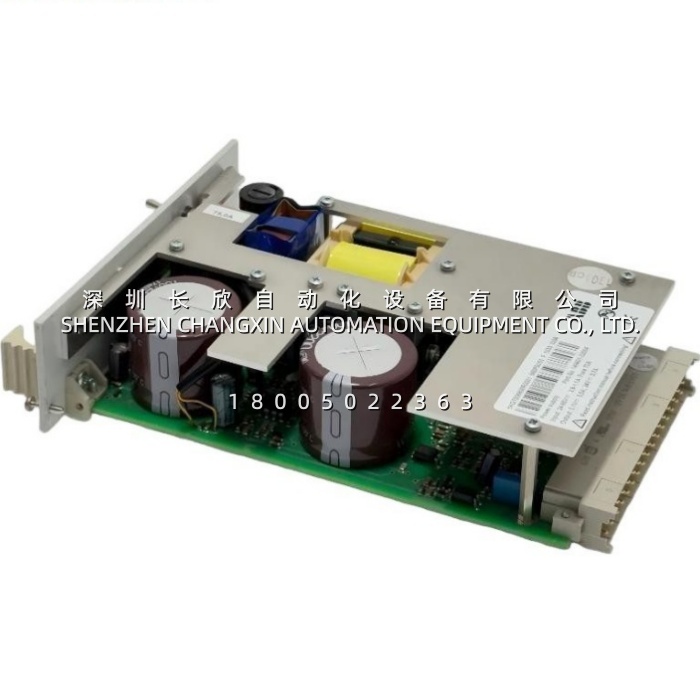
Technical Specifications
| Parameter Name | Parameter Value |
|---|---|
| Product Model | 560CMR01 R0001 |
| Order Number | 1KGT036200R0001 |
| Manufacturer | ABB (ABB Power Grids Germany AG / Hitachi Energy) |
| Product Type | RTU560 Communication Unit (CMU) |
| Product Family | RTU560 / RTU500 series |
| Main Processing Unit | ARM Cortex A8 AM3352 @ 800 MHz, 32-bit |
| RAM / Boot Flash | 128 MByte / 8 MByte |
| SD Card Slot | Push-push, SD 2.0 Class 2, 4 GByte capacity |
| Real-Time Clock | Battery-buffered, lithium CR2032 3 V DC, >10 years, ±50 ppm |
| Serial Ports (CP1/CP2) | 2× RS-232C or RS-485, RJ45, 200 bit/s – 38.4 kbit/s |
| Ethernet Ports (E1/E2) | 2× 10/100BaseT, RJ45, IEEE 802.3 |
| USB Interface | 1× USB 2.0 device, micro USB Type AB, up to 480 Mbit/s |
| I/O Bus | Serial Peripheral Bus (SPB) via backplane |
| Backplane Current | 5 V DC / 500 mA; 24 V DC / 3 mA |
| Dimensions | 160 × 100 mm, 3HE euro card format, 4R (20 mm) front panel |
| Weight | 0.14 kg |
| Connection Type | 48-pole Type F DIN 41612 RTU560 backplane connector |
| Operating Temperature | −25 °C to +70 °C (startup −40 °C; max +85 °C up to 96 h) |
| Relative Humidity | 5% to 95% non-condensing |
| Front-Panel LEDs | ERR, RUN, T, R, S, L |
| Cyber Security Version | R0001 = standard cyber security functions |
| EMC Immunity | IEC 61000-4-2/-3/-4/-5/-6/-18, Performance Criteria A |
Main Features and Advantages
The core engineering strength of the 560CMR01 R0001 is the way it unifies three traditionally separate functions — RTU processor, communication gateway, and time master — on a single 3HE euro card. The ARM Cortex A8 controller executes a real-time operating system dedicated to interface management, event handling, time-base distribution, and the internal process database, while acting as the master of the SPB I/O bus that drives all input and output modules in the RTU560 rack. Because process events are read and output commands issued directly over this serial peripheral bus, scan latency remains deterministic regardless of how many I/O boards populate the subrack, and the CMU remains responsive even under burst-traffic conditions from downstream protection relays or multimeter devices.
Time synchronization is treated as a first-class function rather than an afterthought. The 560CMR01 R0001 receives its reference time from the companion 560RTC0x module across the subrack backplane, distributes that base to every I/O module in the station, and stamps events with a resolution of one millisecond when time synchronization is active. The battery-buffered real-time clock keeps the station coherent through multi-day outages, eliminating the sequence-reconstruction problems that plague RTUs without dedicated RTC support.
Configuration resilience is equally deliberate: all system-relevant files live on a removable 4 GByte SD card, so a failed CMU can be swapped for a spare pre-loaded with the site configuration and returned to service in minutes without a laptop or engineering session. The push-push card slot is accessible from the front panel, supporting hot-configuration updates during planned maintenance windows.
Network versatility is broad for a module of this class. The two serial ports support RS-232C for point-to-point links to master stations or RTU560 sub-devices, and RS-485 for multi-drop integration of sub-RTUs, IEDs, and multimeters. The two 10/100BaseT Ethernet ports handle IEC 60870-5-104, DNP3 LAN, Modbus TCP, and the built-in web-browser HMI that lets an engineer open a diagnostic page from any laptop on the station LAN without installing proprietary software. USB 2.0 provides a direct maintenance channel for engineering tools. Front-panel LEDs report error, run, serial transmit/receive, and Ethernet link/speed status at a glance, and the R0001 cyber-security baseline aligns the module with modern utility requirements for authenticated and encrypted remote access — all within a 0.14 kg board that consumes only 500 mA at 5 V from the backplane, keeping rack power budgets comfortable even in fully populated 560CMR01 R0001 stations.
Application Field
The ABB 560CMR01 R0001 is deployed wherever a substation, distribution feeder, or remote industrial site must be supervised and controlled from a central SCADA master over serial or Ethernet links. Transmission and distribution substations are its primary home, where the module serves as the RTU560 station controller, aggregating protection relay events, breaker and disconnector positions, and analog measurements, then publishing them upward to a network control center over IEC 60870-5-101 (serial) or IEC 60870-5-104 (Ethernet) with the deterministic event ordering that grid operators require for post-disturbance analysis.
In power generation balance-of-plant and renewables — wind farm collector substations, solar inverter stations, and small hydro plants — the 560CMR01 R0001 provides the remote-telemetry layer that bridges local IEDs into the owner’s energy management system, while its web-browser interface supports local commissioning and troubleshooting from a standard laptop. Water authorities and pipeline operators use the module in distribution telemetry outposts where RS-485 multi-drop integration of flow computers, pressure transmitters, and RTU560 sub-stations must coexist with a single Ethernet uplink to the master.
Oil and gas midstream applications — compressor stations, tank farms, and metering skids — rely on the module’s Modbus and DNP3 stacks to concentrate field instrumentation for both local HMI and distant SCADA. Rail electrification, tunnel ventilation, and district heating networks form a further cluster of deployments where hard-real-time event stamping and long RTC autonomy justify the RTU560 platform.
Equally important is the sustainment role the 560CMR01 R0001 plays in brownfield programs: utilities and industrial operators with large installed fleets of RTU560 stations continue to procure this communication unit to replace age-out boards, add redundant CMUs to critical substations using the 560BCU05 bus connection unit, and standardize spares pools across regional depots. Because the R0001 and R0002 variants share the same mechanical, electrical, and functional baseline, an existing station can be upgraded to a higher security tier simply by swapping the CMU and reloading configuration — an upgrade path that preserves the original I/O modules, wiring, and engineering documentation without a full RTU retrofit.