WhatsApp:+86 18005022363 WeChat: +86 18005022363
  Email:
Description
Application Scenarios:
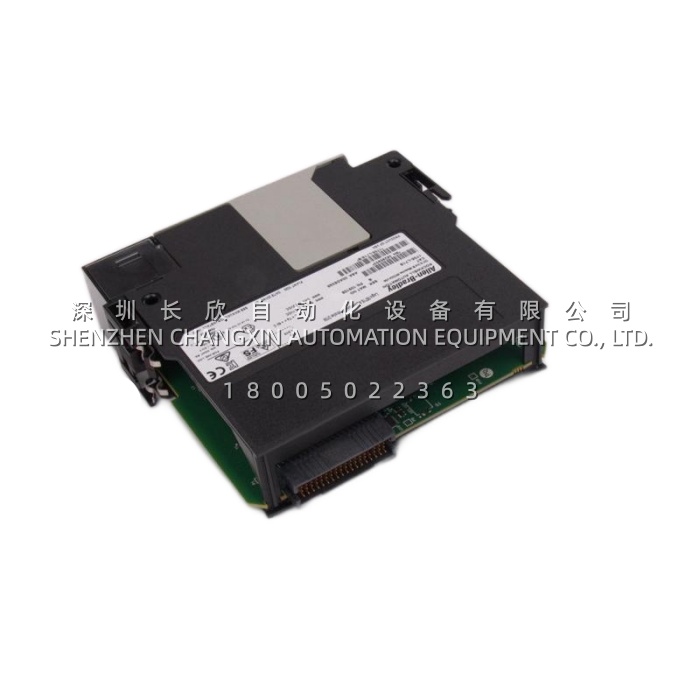
Picture a municipal water treatment plant that has just upgraded from a centralised marshalling cabinet to distributed POINT I/O drops mounted directly in the field, several hundred metres from the control room. Every dosing pump, control valve and chemical feed skid needs a 4–20 mA command signal, and the maintenance team’s biggest complaint has always been the same: when a loop goes dead, nobody can tell whether the wiring broke, the field power dropped, or the PLC card failed.In this setting, the 1734-OE2C sits at the last link of the control chain. It takes the PID output computed in a CompactLogix controller and turns it into a current that a valve positioner can act on, while its per-channel status LEDs flash red the instant an open wire or a loss of field power occurs. The pain point it removes is diagnostic blindness — instead of sending a technician out with a multimeter to walk the loop, the operator sees the fault on the module face and in the controller’s fault status bits within seconds.The same story repeats in packaging machinery, where a 1734-OE2C provides the speed reference to a variable frequency drive, and in OEM skids where two channels of analog command are needed but panel space allows for barely a finger’s width of DIN rail. Because the module outputs 0 mA until communication is established, downstream actuators stay safely parked during commissioning rather than jumping to an unintended position on power-up.
Parameter:
| Main Parameters | Value/Description |
|---|---|
| Product Model | 1734-OE2C |
| Manufacturer | Allen-Bradley (Rockwell Automation) |
| Product Category | POINT I/O analog current output module |
| Number of Outputs | 2 single-ended, non-isolated current channels — one module commands two independent loops |
| Output Signal Range | 0–20 mA or 4–20 mA, user-configurable per channel (4–20 mA default) |
| Resolution | 13 bits over 0–21 mA, approx. 2.5 µA/count — fine enough for smooth valve modulation |
| Absolute Accuracy | 0.1% of full scale at 25 °C, drift 30 ppm/°C — holds calibration across seasonal temperature swings |
| Step Response / Conversion Rate | 24 µs to 63% of full scale, 16 µs conversion — tracks fast-changing PID outputs without lag |
| Resistive Load Range | 0–750 Ω — drives long cable runs and most industrial positioners and I/P converters |
| POINTBus Current / Field Supply | 75 mA @ 5 V DC backplane; 70 mA @ 24 V DC external (10–28.8 V DC range) |
| Isolation Voltage | 50 V continuous (basic insulation), tested at 2200 V DC for 60 s field-side to system |
| Data Format / Calibration | Signed integer; factory calibrated, no field calibration required |
| Communication Interface | POINTBus backplane via 1734-AENT, 1734-AENTR, ControlNet or DeviceNet adapters |
| Physical Dimensions | 56 × 12 × 75.5 mm, approx. 36 g — the 12 mm width is the real space saver |
| Installation Method | DIN rail mount into 1734-TB, 1734-TBS, 1734-TB3 or 1734-TB3S terminal bases; keyswitch position 4 |
| Environmental Adaptability | –20 °C to +55 °C operating, 5–95% non-condensing humidity, 5 g vibration, IP20 open-style |
Technical Principles and Innovative Values:
- Innovation Point 1 — Digital-to-analog conversion with genuine 13-bit granularity: The 1734-OE2C uses a dedicated DAC that spreads its counts across 0–21 mA rather than across the usable 4–20 mA band only. The practical result is roughly 2.5 µA per count, meaning a control valve can be positioned in increments fine enough to eliminate the hunting and overshoot that coarser 8- or 10-bit outputs cause in tight process loops.
- Innovation Point 2 — Per-channel, per-scaler configurability: Default scaling is 1638 counts at 4 mA and 8191 counts at 20 mA, but each channel can be re-scaled independently. A single 1734-OE2C can therefore command a 0–20 mA drive reference on channel 0 and a 4–20 mA valve positioner on channel 1, with the engineering-unit conversion handled inside the module instead of in ladder logic.
- Innovation Point 3 — Built-in open-wire and field-power diagnostics: Any open circuit or loss of field power sets a general status bit and blinks the corresponding channel LED red. Competing two-channel output cards in this class typically report only module-level health, so the 1734-OE2C shortens fault isolation from “check the whole loop” to “check channel 1”.
- Innovation Point 4 — Safe startup behaviour: Outputs are held at 0 mA until communication with the adapter is established. This prevents the all-too-common commissioning incident where a valve slams open or a drive ramps to full speed because an unconfigured card woke up with residual output data.
- Innovation Point 5 — True distributed density at 12 mm: Compared with rack-based analog output cards that occupy a full slot for two channels, the 1734-OE2C delivers the same function in a twelfth of the width, letting machine builders place analog outputs next to the actuators they control rather than pulling home-run cables back to a central cabinet.
- Innovation Point 6 — Hot-swappable field replacement (RIUP): Combined with a removable terminal base, the module can be exchanged while the rest of the POINT I/O rack stays live, which is exactly what continuous-process plants need when uptime is contractually measured in nines.
Application Cases and Industry Value:
Case 1 — Chemical dosing skid, water and wastewater: A regional utility retrofitted twelve chemical feed skids with distributed POINT I/O drops, each carrying one 1734-OE2C for the metering pump speed command and the back-pressure control valve. Before the retrofit, loop faults averaged 3.5 hours of troubleshooting time because technicians had to isolate the signal path manually. With the 1734-OE2C open-wire indication visible both on the module and in the controller tags, that figure dropped below 30 minutes. The utility also reported a measurable improvement in dosing accuracy — the 13-bit output let the PID trim the pump in far smaller increments, cutting chemical consumption by a few percentage points per month, which on a plant of that size is a line item the finance department notices.Case 2 — High-speed packaging line, food and beverage: A packaging OEM needed two analog outputs per station for film tension control and conveyor speed reference, with only 60 mm of spare DIN rail per panel. Two 1734-OE2C modules, mounted on 1734-TB3 bases alongside digital I/O on a single 1734-AENTR adapter, replaced a bulky central analog rack entirely. The 24 µs step response proved critical during rapid product changeovers, where the tension loop had to re-settle within milliseconds of a recipe switch. Commissioning time per machine fell by roughly a day, and because the modules are factory calibrated, the OEM eliminated the calibration step from its factory acceptance test altogether — no trim pots, no certificates to reissue, no drift to chase in the field.
Related Product Combination Solutions:
- 1734-OE4C — Four-channel version of the same current output family; pair it with the 1734-OE2C when a drop needs six or more loops, or standardise on it for larger skids while keeping the two-channel unit for space-constrained stations.
- 1734-OE2V — Two-channel analog voltage output module (±10 V, 0–10 V); the natural companion when one part of a machine needs a drive speed reference in volts and another needs a valve command in milliamps.
- 1734-IE2C — Two-channel analog current input module; combine with the 1734-OE2C to close the loop, reading 4–20 mA transmitter feedback against the command the output module is issuing.
- 1734-AENTR — EtherNet/IP POINT I/O adapter with device-level ring capability; the bridge that puts 1734-OE2C data onto the plant network and supports resilient topologies for continuous processes.
- 1734-TB3 and 1734-TBS terminal bases — Three-wire and fused / disconnect variants respectively; the 1734-OE2C seats into either, and the removable terminal block lets you swap a module without disturbing field wiring.
- 1734-EP24DC — Expansion power module that injects fresh 24 V DC field power partway down a POINT I/O bank, essential when several 1734-OE2C modules push the field-side current budget close to its limit.
- 1734-IB4 and 1734-OB4E — Four-point digital input and electronically protected output modules; the everyday partners that share the same rack and give a complete mix of discrete and analog control on one adapter.
- 1734sc-OE2CIH — A functionally adjacent two-channel isolated output module with HART master on each channel, worth specifying alongside the 1734-OE2C where smart positioners need digital communication in addition to the analog command.