WhatsApp:+86 18005022363 WeChat: +86 18005022363
  Email:
Description

Application Scenarios
A plant has a 1336 PLUS AC drive running a critical conveyor or pump. The drive is mechanically sound and electrically healthy, but its only network interface is SCANport — and the plant’s control system speaks Remote I/O through a PLC-5 or an SLC 500 with a 1747-SN scanner. The options look grim: replace a working drive purely to gain connectivity, or run analog wiring and accept the noise, drift and diagnostic blindness that comes with it.This is precisely the problem 1203-GD1 was built to solve. Mounted on DIN rail in the drive cabinet, it lets the drive appear as a standard I/O rack on the RIO link, so the controller delivers start/stop logic commands and speed references and reads back logic status and speed feedback as ordinary I/O words. The pain points it removes are concrete: the analog wiring that picks up interference near drives, the inability to read drive fault data centrally, and the capital cost of replacing serviceable hardware for the sake of a network interface.The second scenario is the retrofit and life-extension case. SCANport-era products — 1305 AC MICRO, 1336 IMPACT, PLUS, PLUS II, FORCE, REGEN, SPIDER, 1394 multi-axis, SMC Dialog Plus, SMP-3, 1397 DC drives, 1557 medium voltage drives — remain in service decades after installation. 1203-GD1 lets those assets stay on the network they were designed for, which is why it remains a high-demand spare rather than a museum piece.
3. Parameter
| Main Parameters | Value/Description |
|---|---|
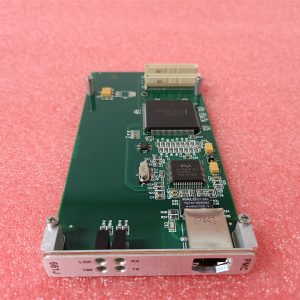
| Product Model | 1203-GD1 (Bulletin 1203, Remote I/O to SCANport) |
| Manufacturer | Allen-Bradley / Rockwell Automation, USA |
| Product Category | Remote I/O communications module / SCANport network adapter |
| Function | Direct digital link between an Allen-Bradley programmable controller and one SCANport product; one module required per device |
| Input Voltage | 85–264 V AC, single phase — the widest supply range in the family, works on 115 V or 230 V without modification |
| Input Current and SCANport Load | 35 mA maximum input current; 60 mA DC SCANport load; input frequency 45–63 Hz |
| Communication Interfaces | One 8-pin mini-DIN SCANport connection; one 3-pin Remote I/O connector; daisy-chainable power terminals |
| Baud Rates | 57.6 Kbaud, 115.2 Kbaud, 230.4 Kbaud — set by DIP switch SW2.7 and SW2.8 |
| I/O Capacity and Rack Sizes | 8 words maximum in each direction; rack sizes 1/4, 1/2, 3/4 or full, selected to match enabled features |
| Configuration Method | Three DIP switch banks: SW3 for I/O sizing and datalinks, SW1 for rack address, SW2 for starting group, last rack, fault action and baud rate |
| Environmental and Mechanical | 0 to 50 °C operating, −40 to 85 °C storage, 0–95 % RH non-condensing; 76 × 45 × 123 mm, NEMA Type 1 (IP30); standard 35 × 7.5 mm DIN rail; UL, CSA, CE marked |
| Diagnostics | Five LEDs — Fault, SCANport STS, Health, Rem I/O ACT, Rem I/O STS — giving instant visual status of module, SCANport link and RIO link |
4. Technical Principles and Innovative Values
- Innovation Point 1 — Rack emulation instead of protocol translation overhead: 1203-GD1 does not merely convert messages; it makes the SCANport device behave like a remote I/O chassis. The scanner moves I/O image table data the same way it does for any RIO device, so no special driver, gateway programming or controller-side protocol stack is needed.
- Innovation Point 2 — Hardware-configured, software-free commissioning: rack address, baud rate, I/O sizing, datalinks, block transfer, fault response and hold-last-state are all set by DIP switches. A technician can stage a replacement module in minutes with a 1/8″ flathead screwdriver, with no laptop, no firmware download and no licensing step.
- Innovation Point 3 — Scalable I/O footprint from quarter rack upward: the module lets you size the connection to the application. A quarter rack covers basic control; enabling reference/feedback, logic status and datalinks expands to half, three-quarter or full rack. Each enabled datalink consumes two 16-bit words in each direction, and SW3.8 truncates the last datalink to one word when the 8-word RIO limit is tight.
- Innovation Point 4 — Datalinks for parameter access without block transfers: 1203-GD1 supports SCANport datalinks, which act as pointers letting a controller read or change parameter values directly. This gives fast, continuous access to drive data without the programming complexity and scan-time cost of block transfer messaging — a genuine efficiency gain for monitoring-heavy applications.
- Innovation Point 5 — Deterministic fault behaviour that protects the process: SW2.4 through SW2.6 define what happens on communication loss — whether the module holds last state or zeroes data, and how the connected product responds when the controller enters program or test mode. Setting this correctly is what separates a controlled stop from an uncontrolled one.
- Innovation Point 6 — Diagnostics visible without tools: five status LEDs report module health, SCANport link state and Remote I/O activity. Most connectivity faults can be triaged by looking at the module, which is exactly what matters at 2 a.m. in a running plant.
- Innovation Point 7 — Broad cross-generational compatibility: 1203-GD1 works with SCANport products spanning AC drives, DC drives, motion systems, smart motor protectors and medium voltage drives, and with controllers from PLC-2/30 through PLC-5, PLC-5/250, SLC 500 with 1747-SN, and Logix5550. One module family covers an entire installed base.