WhatsApp:+86 18005022363 WeChat: +86 18005022363
  Email:

Description
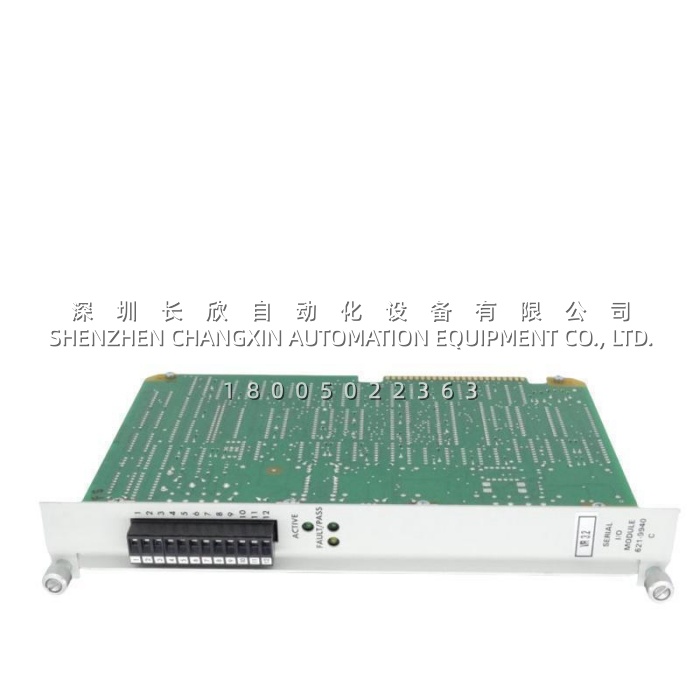
Application Scenarios:
A bulk-chemicals terminal loads road tankers across eight loading bays spread over roughly 400 metres of pipe rack. Each bay has its own local I/O — valve position feedback, permissive contacts, flow-meter pulse inputs, earthing interlocks and batch totaliser signals — and the plant’s IPC 620 processor sits in a control room at one end of the site. Running every one of those field cables back to the processor rack would mean hundreds of long parallel runs through a classified area, an installation cost the project could not justify and a maintenance burden the plant did not want.The architecture the plant built instead puts a small remote I/O card file at each loading bay, and each of those card files is governed by a 621-9940C. The module sits in slot N of its rack, gathers the state of every I/O module beside it, and reports it up a single serial channel to the 621-9939 SLM in the processor card file. Because the 621-9940C lets each slot in the rack be configured independently for 0, 8, 16 or 32 points, the plant can mix a 32-point digital input card, a 16-point output card and an 8-point analog card in the same rack without wasting addressing space — and because its starting address is set in increments of eight anywhere from 0 to 2,032, every bay gets a unique, non-overlapping block in the processor’s I/O map. When a new bay was added two years later, the commissioning work was essentially: set SW1 on the new 621-9940C to a free address, set SW3 through SW5 for the slot densities, terminate the channel properly, and the processor saw the new rack.That pattern is the reason the 621-9940C exists and the reason it still matters. It appears wherever I/O has to be distributed away from the processor — conveyor lines in mining and cement, remote wellhead and pump stations in oil and gas, distributed water and wastewater lift stations, long packaging and material-handling lines, and multi-bay batch plants. In every one of these, the pain point it resolves is the same: the cost, complexity and electrical noise exposure of pulling every field signal back to a central rack. One serial channel replaces hundreds of home-run cables, and the 621-9940C is the card that makes that channel work.
Parameter:
| Main Parameters | Value / Description |
|---|---|
| Product Model | 621-9940C |
| Manufacturer | Honeywell |
| Product Category | Serial I/O Module (SIOM) — serial I/O rack controller / remote I/O interface card |
| Host System | Honeywell IPC 620 / IPC 621 programmable controller family (621 I/O subsystem) |
| Rack Slot Assignment | Slot N in a full-size I/O rack; slot H in an I/O half rack / remote serial I/O card file |
| Partner Module | Interfaces with the 621-9939 SLM (Serial Link Module) located in the processor card file |
| Core Function | Collects data from all I/O modules in its card file and exchanges it with the SLM over the serial channel; controls the serial I/O card file |
| Configuration Interface | Four 8-position DIP switch banks (SW1-SW4) plus one 4-position DIP switch (SW5) on the circuit board |
| SW1 — Starting Address | Selects the absolute starting address of the card file, from 0 to 2,032 in increments of eight; the SLM reads this at start-up and sequences the channel accordingly |
| SW2 — Fault Response | Sets the rack output states on a fault and selects auto-test or normal operation — determines whether outputs hold, or go to a defined safe state when the link drops |
| SW3 / SW4 / SW5 — Slot Density | Determine the number of I/O points allocated to each slot in the card file: 0, 8, 16 or 32 points per slot |
| I/O Capacity Constraint | Total points across all card files must stay within the I/O capacity of the 620 Logic Controller; overlapping SIOM addresses and addresses above 2,032 are prohibited |
| Serial Link Cable | Honeywell specifies Belden 9729 or equivalent for the serial channel |
| Termination Requirement | Terminating resistors at each extreme end of the serial channel to match cable impedance — 200 Ω at ½ watt (200 or 300 Ω depending on configuration); two resistors in each SIOM at the extreme end of a multidrop link |
| Hot Insertion | The “R” suffix denotes modules that can be removed or inserted while the rack remains powered; the 621-9940C carries the “C” suffix for CE Mark and should be de-energised before handling unless your local procedure states otherwise |
| CE Compliance | “C” suffix conforms to CE directives 73/23/EEC (Low Voltage) and 89/336/EEC (EMC) |
| Redundancy Variant | 621-9938RC is the redundant serial I/O module with dual communication ports for redundant serial I/O lines; the 621-9940C is the standard, non-redundant SIOM |
| Diagnostics | On-board LED status indicators for power, communication and fault condition |
| Power Supply | From the I/O rack backplane / rack power supply |
| Operating Temperature | 0 °C to +60 °C; storage -40 °C to +85 °C; 5-95% RH non-condensing (per distributor listings) |
| Dimensions | 264 × 32 × 127 mm |
| Weight | Approximately 0.61 kg |
| Availability | Discontinued by the original manufacturer; supplied as new surplus or tested refurbished stock for sustaining installed IPC 620 systems |