WhatsApp:+86 18005022363 WeChat: +86 18005022363
  Email:
Description

Technical Specifications
| Parameter Name | Parameter Value |
|---|---|
| Product Model | 586-501-109 |
| Manufacturer | Reliance Electric (now part of Rockwell Automation) |
| Product Type | DCS Network Communications Module |
| Compatible System | Reliance Electric AutoMax / DCS 5000 distributed control systems |
| Core Function | Exchange of control and status data between two or more AutoMax controllers on the same network |
| Communication Speed | 845 kbaud, deterministic synchronous serial |
| Maximum Network Length | 3000 ft (approx. 914 m) per distributed network trunk |
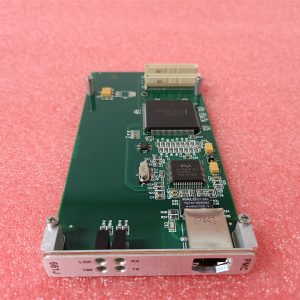
| Network Port | 9-pin D-shell connector, labelled NETWORK (synchronous serial rack-to-rack link) |
| Monitor Port | 25-pin D-shell connector, labelled MONITOR (RS-232C asynchronous diagnostics) |
| Node Addressing | Two thumbwheel switches, DROP NUMBER 1ST (most significant) and 2ND (least significant) |
| Status Indication | 7-segment LED fault code display plus green module status light |
| Backplane Interface | Dual edge connectors (P1/P2 female card slots) on the AutoMax rack backplane |
| Power Supply | From the AutoMax rack backplane (typical 5 V DC, verify against host rack documentation) |
| Form Factor | Single-slot AutoMax rack plug-in printed circuit assembly with front faceplate and ejector tabs |
| Dimensions / Weight | Approx. 250 × 35 × 120 mm; approx. 0.63 kg (verify against the actual unit) |
| Operating Environment | Industrial control cabinet, standard AutoMax rack ambient rating (verify per host system) |
| Lifecycle Status | Discontinued / obsolete; supplied as new surplus or professionally tested spare |
Main Features and Advantages
Deterministic rack-to-rack data exchange: The 586-501-109 exists to make physically separate AutoMax controllers behave as one machine. At 845 kbaud over a synchronous serial trunk, it moves control references, status words and interlocks between racks with predictable latency, which is the property that matters in coordinated drive applications — a section that receives its speed reference late is a section that tears the web. Distributing processing across several controllers while holding a single logical machine together is precisely the problem this module was designed to solve.Network reach without repeaters: Supporting distributed network runs of up to 3000 feet, the 586-501-109 covers most industrial footprints on a single trunk. In a paper machine, a converting line or a long conveyor system, that reach removes intermediate hardware and the additional failure points it would introduce, while keeping the drop count and topology simple enough to document and troubleshoot years later.Addressing that is read at the hardware level: The two DROP NUMBER thumbwheels give every node a unique, visible, human-settable address without software configuration, jumpers or firmware tools. That is a genuine maintenance advantage on legacy equipment: the setting can be verified by eye during a walk-down, recorded on a laminated network map, and restored correctly by a technician who has never opened the programming software.Diagnostics designed for the person on the floor: A seven-segment fault code display and a green status LED report module health directly on the faceplate, and the RS-232C MONITOR port allows an ASCII terminal to be connected for deeper internal diagnostics. Together these turn a network failure from an open-ended investigation into a code lookup, which is exactly what is needed at two in the morning on a stopped line.Mechanical and electrical drop-in fit: As a single-slot backplane assembly with P1/P2 edge connectors, ejector tabs and faceplate retention, the 586-501-109 installs in minutes with no wiring changes, no configuration download and no re-commissioning of the control strategy. A like-for-like replacement restores the rack to its original behaviour, preserving the tuned performance and responsiveness the process depends on.
Application Field
The 586-501-109 is applied wherever an AutoMax installation distributes control across multiple racks rather than concentrating it in one chassis. The classic environment is web processing and converting: coating lines, laminators, slitters, rewinders and printing presses, where unwind, infeed, coating, drying, outfeed and rewind sections each run their own AutoMax rack but must share a single line-speed reference and coordinated tension profile. The module carries that shared data between racks.In pulp and paper, the 586-501-109 links stock preparation, press, dryer and calender sections, and in metals it connects the stands, bridles and coilers of a rolling or processing line, where section-to-section speed matching and torque sharing cannot tolerate variable communication latency. Material handling installations — long conveyor systems, sortation lines, warehouse transfer cars and automated storage cranes — use the module’s 3000 ft reach to span distances that would otherwise require remote I/O drops or additional controllers.Beyond coordinated drives, the 586-501-109 supports distributed machine control in general manufacturing: multiple AutoMax controllers supervising separate process stages that must exchange permissive, interlock and status information continuously. Water and wastewater, cement, mining, and power-plant balance-of-plant equipment also appear in the installed base.What unites these applications is the problem the module solves: an obsolete but functioning AutoMax system where the barrier to continued operation is the availability of one discontinued network card. The 586-501-109 is the difference between restoring synchronisation with a single board swap and facing an unplanned migration of an entire control platform.
Related Products
57C404C — The Network Communications Module of the AutoMax family with the same functional role as the 586-501-109: 845 kbaud, 3000 ft trunk, 9-pin NETWORK and 25-pin MONITOR ports, dual drop-number thumbwheels and a 7-segment fault display; the “C” revision carries updated firmware, so revision compatibility must be checked before substitution.57C404B — The preceding hardware revision of the same network module; it shares the faceplate layout and network behaviour but may differ in firmware, so it should only be fitted where the rack and application documentation permit.57C416 — The Remote I/O Communications Module that distributes I/O across remote drops using the proprietary AutoMax Remote I/O network; it complements the 586-501-109 by handling field I/O distribution rather than controller-to-controller data exchange.57C328 — A Remote I/O Head that houses the I/O rails at a remote drop and communicates back over the Remote I/O coaxial network, with its own drop-number thumbwheels and seven-segment diagnostics.57C329 — The Remote Drive Interface Head, serving the same distributed role as the 57C328 but dedicated to interfacing up to four drives, including Ready Relay contacts intended for emergency-stop circuits.57C330 — A Remote I/O Head variant with an on-board supply providing all voltages for the head and its I/O system, used where the drop must power its own I/O.57C554 — The Shark Interface Module, which connects Shark drives into the AutoMax Remote I/O network and works alongside the communications modules in drive-heavy architectures.57C331 — The 16-slot AutoMax rack assembly that provides the Multibus backplane into which modules such as the 586-501-109 plug; larger systems use this rack while smaller ones use fewer-slot variants.57C493 — An AutoMax rack power supply compatible with racks such as the 57C331; it generates the backplane voltages on which every installed module, including the 586-501-109, depends.56AMXN/B — The ControlLogix AutoMax DCSNet and Remote I/O communication interface module, a migration bridge that lets a ControlLogix processor act as a DCS master or slave on an existing AutoMax network; relevant when a plant is planning a staged replacement of the architecture the 586-501-109 serves.